The morning you realize speed became chaos
It starts with the best of intentions. Your team has a crisp PRD for a new onboarding flow. Someone opens Cursor, pastes in the doc, asks the agent to break it into engineering tasks, and hits Enter. Minutes later, 60 Jira issues appear. The bot cheers. The board looks full. On paper, velocity is about to soar.
Then the doubts hit. Which tickets matter for the first release? Which tie to real user goals versus internal cleanups? What depends on what? Which part of the journey are we even improving? Without a narrative to anchor the work, the board becomes a scatter plot of effort instead of a sequence that delivers value.
This is the congestion created by speed: flat backlog chaos. It’s what happens when an AI agent is told to generate without being told to understand. Tasks multiply, context collapses, and the gap between human strategy and autonomous execution widens with every new ticket.
Flat backlog chaos in five symptoms
- Everything looks urgent because nothing is contextualized. Priority fields exist, but they’re arbitrary without a shared journey behind them.
- Dependencies live in comments, not in structure. Engineers discover order late in standups instead of early in planning.
- Scope creep dresses up as thoroughness. The agent “helpfully” creates edge-case tasks before the core flow is even validated.
- Stakeholders can’t see the why. They see 60 issues and two sprints, not the user goal those sprints are meant to achieve.
- Rework climbs. Tickets bounce back after review because they optimized local tasks, not the end-to-end experience.
The missing layer is context, not more tickets
Fast code and rapid ticket creation aren’t the culprits. They’re accelerants. The root cause is that the agent operates without a model of the product’s narrative: the jobs to be done, the user steps, the release boundaries, and the thin slices that must ship together to deliver value. In other words, the agent lacks a map.
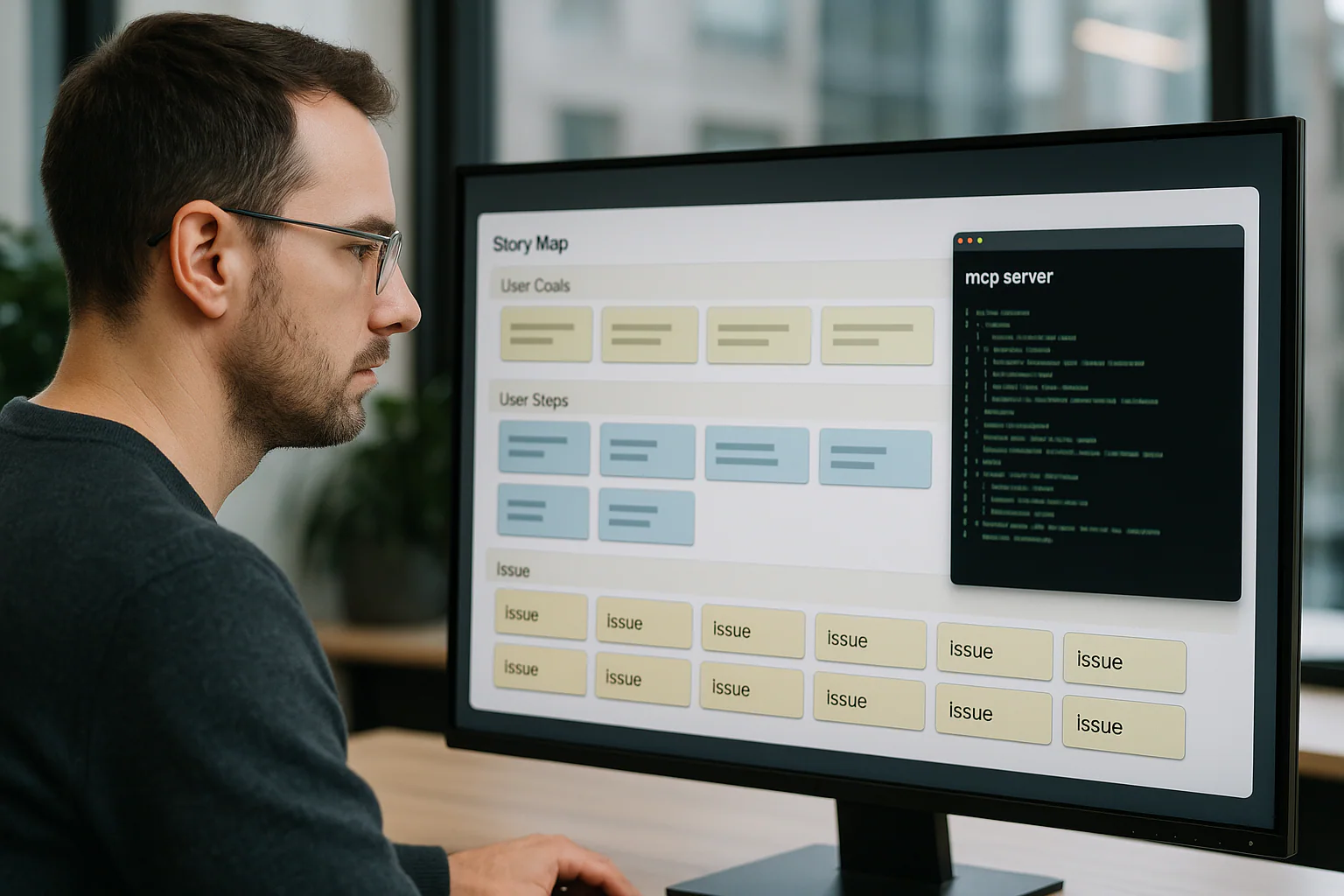
For humans, the antidote is a story map: a structured view with user goals or activities at the top, steps in the middle, and stories at the base. The story map aligns strategy and execution because it makes the end-to-end experience visible and negotiable. It shows how to assemble a realistic MVP, which steps can wait, and where risks live. It is planning — but more importantly, it is context.
Make context a reusable asset
Story maps work best when surrounding decisions are visible and reusable. Turning them into a shared service helps agents stay grounded during rapid change.
See how to operationalize Context across teams with lightweight rituals and examples you can adopt immediately.
For AI, the story map must become machine-readable context. Prompts and PRDs aren’t enough; they’re static and flat. What the agent needs is a living model it can query: the hierarchy, the slices, the relationships, and the latest decisions. That’s why teams are adding a new connective layer between human intent and agent action: a map-aware interface the agent can access.
How the mcp server turns story maps into machine context
- It exposes structure, not just text. Instead of a blob of requirements, the agent receives the hierarchy of goals, steps, and stories — plus release slices.
- It grounds generation. When the agent proposes tasks, it attaches them to the right user step and release scope, preventing orphan tickets.
- It keeps the map as the source of truth. Planning updates — a re-scoped MVP, a renamed step — flow back to the agent through a consistent protocol.
- It provides relationship hooks. The agent can query dependencies, acceptance criteria, and status, so it writes code and tickets in sequence, not in isolation.
- It reduces prompt fragility. Instead of brittle, verbose prompts trying to mimic structure, the agent relies on a stable schema from the server.
Inside the StoriesOnBoard mcp server: what your agent can see
StoriesOnBoard has always helped humans see the big picture: goals and activities at the top, user steps in the middle, user stories below — with clear slices for MVPs and upcoming releases. The StoriesOnBoard MCP server extends that clarity to AI agents. Through a standard interface, the agent can “read” the story map like a team does in a kickoff. It can traverse the hierarchy, see which steps compose the current release, and retrieve acceptance criteria written in a modern, collaborative editor.
Crucially, the context is live. Product managers and UX leads can refine the map during discovery, annotate tradeoffs, and lock in a release slice. Those decisions propagate through the MCP server so the agent stops working in a vacuum. When engineering imports and syncs issues with GitHub or Jira, they don’t abandon the map — they keep it as the source of truth.
Because StoriesOnBoard supports fast collaboration — presence indicators, flexible editing, and built-in AI that helps write stories and criteria — the map stays fresh. The agent gets a narrative that evolves with stakeholder input, not a frozen PDF. The outcome isn’t just fewer tickets; it’s fewer meaningless tickets.
From PRD to purposeful tickets: a new flow teams can trust
- Anchor on outcomes. Start with user goals and steps in the story map so the team aligns on the narrative before any ticket is created.
- Slice the release. Mark the minimal set of steps and stories that create a coherent experience; defer the rest intentionally.
- Let the agent generate within bounds. With the map visible through the StoriesOnBoard MCP server, the agent proposes tasks attached to the slice, not the entire PRD.
- Enforce relationships. Each generated ticket links back to its user step, acceptance criteria, and dependencies, creating traceability without extra meetings.
- Sync with delivery, keep the source. Push issues to GitHub or Jira via StoriesOnBoard’s integrations, but use the map to manage scope and communicate progress.
Human alignment stays visible while agents move fast
Engineering managers don’t need another dashboard; they need a shared understanding that holds when the team is moving at AI speed. A story map is that shared context made visual and persistent. It’s where the conversation lands when a stakeholder asks, “Can we add SMS verification to onboarding?” Instead of blowing up the backlog, you locate the change within a step, negotiate what drops from the MVP slice, and instruct the agent accordingly — all while keeping a coherent journey.
Because StoriesOnBoard keeps the conversation anchored to the map, scope changes become strategic decisions rather than opportunistic additions. The agent still helps write user stories, draft acceptance criteria, and break down work — but within the boundaries you’ve drawn. The speed stays; the sprawl doesn’t.
Beyond prompts: why an mcp server beats ad hoc plugins
- Stable schema over brittle prose. Prompts try to describe structure with words; an mcp server represents it explicitly so the agent can reason about it.
- One source of context, many agents.
Operationalize MCP-driven backlog flow
Once your map is machine-readable, you still need guardrails: how tasks are proposed, reviewed, and synced without reintroducing chaos.
This guide shows how product teams wire the story map into a real backlog using MCP including workflows, governance checks, and rollout steps.
As teams add agents (coding, test, docs), each consumes the same map context instead of divergent prompt hacks.
- Bidirectional understanding. The agent can ask, “Which stories are in Release 1?” or “What’s the acceptance criteria for Step 3?” — not just generate on command.
- Security and governance. The server mediates what the agent can access and update, keeping human oversight intact without throttling speed.
- Extensible by design. As your story map evolves (labels, priorities, risks), agents inherit richer signals without rewriting every workflow.
What changes for engineering managers and product leads
The daily reality gets saner. Planning shifts from ticket triage to journey shaping. Standups focus on progress through a slice, not isolated status. Dependencies are anticipated in the map and shepherded by the agent, not discovered mid-sprint. When leadership asks, “What’s in the MVP and why?”, you point to a clear release lane instead of a spreadsheet of tasks.
For product leads, the map becomes the backbone of cross-functional conversations. UX can highlight gaps in the end-to-end flow. Support and sales can see what the MVP covers and what it won’t. Marketing can align announcements to tangible user milestones. And because StoriesOnBoard integrates with GitHub and other delivery tools, engineering teams don’t have to choose between visibility and execution — they get both, with the map as the narrative layer.
Evidence your system works: measurable signals
- Ticket-to-story traceability. Each issue links back to a user story and step; orphaned tasks approach zero.
- Reduced rework. Fewer tickets bounce between code review and product review because acceptance criteria came from the map, not afterthoughts.
- Cycle time aligns to slices. Work moves in coherent chunks aligned to the release lane, not random clusters that “happen to finish.”
- Cleaner stakeholder updates. Progress reporting maps to user goals achieved, not to a tally of completed tasks.
- Lower meeting load. Fewer clarification standups because relationships and scope were encoded in the map the agent consumed.
Choose your command layer wisely: the mcp server as control plane
When people hear “AI control,” they imagine a new console. But command and control for AI development teams isn’t another UI; it’s a language of structure both humans and machines can use. A story map gives you that language. The mcp server makes it speakable by an agent. Together, they form the control plane: humans set direction in a medium that reflects user reality, and agents execute within it without erasing intent.
In StoriesOnBoard, this control plane is practical, not theoretical. The map is where discovery happens, ideas are captured, and acceptance criteria are authored with AI assistance. The StoriesOnBoard MCP server carries that structure to your agents so they can create tickets, propose code changes, and suggest tests anchored to the same narrative. Your delivery tools remain in play — GitHub issues are imported and synced, labels filtered — but the map stays the source of truth. The result is a team that moves quickly and stays coherent.
The morning after, without the map: what fails
- Tickets decouple from outcomes. Velocity rises, value stalls, and retros devolve into “we did a lot, but what did we change?”
- Scope drifts. Agents expand edge work because no slice tells them what “good enough” means for Release 1.
- Hidden dependencies bite. Work lands out of order, reveals late blockers, and burns extra coordination cycles.
- Stakeholder trust erodes. Leaders stop reading issue trackers because they don’t map to user goals they care about.
- Teams normalize rework. QA and PM become clean-up crews for structure the system never encoded in the first place.
Case vignette: the same PRD, two different weeks
Consider two teams with the same onboarding PRD. Team A pastes it into an AI agent and greenlights whatever comes back. They get 60 issues — mostly plausible, many redundant. The sprint starts with bravado and ends with backfill: missed dependencies, a brittle MVP, and a frustrating review cycle. The backlog looks full. The release, somehow, feels empty.
Team B opens a story map in StoriesOnBoard. They lay out user goals: Discover, Sign Up, Verify, First Use. They detail steps for Sign Up and define what “good enough” means for Release 1. They capture acceptance criteria with help from StoriesOnBoard’s built-in AI. Then their coding agent reads that map through the StoriesOnBoard MCP server. It proposes tasks only for the scoped steps, links each ticket to its story, threads dependencies through the steps, and syncs with GitHub. The sprint feels fast and quiet. Fewer surprises, more momentum. The same PRD; a very different week.
What about creativity? Will structure make agents rigid?
The concern is fair: if we bind the agent to a map, do we muzzle its imagination? In practice, structure channels creativity. By generating inside a narrative, the agent can suggest better ways to reach an outcome rather than more ways to pad a backlog. It can still surface edge cases and optimizations — but now as explicit tradeoffs within a release lane, not as unbounded scope creep.
Good maps are living documents. StoriesOnBoard supports rapid edits, live presence, and flexible text so changing your mind is cheap. When the team discovers a better path, the map changes — and through the mcp server, the agent learns the new terrain. That’s not rigidity; that’s adaptive clarity.
Why story mapping belongs before coding agents, not after
In the age of AI development, many teams inverted the sequence: generate tasks first, then retrofit a structure so humans can understand the mess. It should be the opposite. Do the thinking only humans can do — negotiating goals, slicing releases, defining what value means — then let agents accelerate execution inside that shape. A story map isn’t red tape; it’s the minimal structure that keeps speed from dissolving into noise.
When this sequence is respected, the qualitative benefits show up immediately: calmer standups, clearer tradeoffs, and release notes that make sense to customers. The quantitative gains follow: fewer carryovers, less rework, tighter feedback loops. The toolchain adapts to this logic. StoriesOnBoard sits at the strategy layer. Delivery platforms do what they do best. The mcp server is the bridge.
Addressing the skeptical questions
- “Can’t we just write better prompts?” You can make prompts longer; you can’t make them structural. A map plus an mcp server is the durable version of a great prompt.
- “Isn’t this more process?” It’s less, net, because the structure removes the need for repeated clarifications and firefighting mid-sprint.
- “What if our map is wrong?” Great — fix it. With StoriesOnBoard, the cost of change is low, and the server propagates updates to agents quickly.
- “Won’t agents get slower if we constrain them?” They’ll get faster on the right things. Throughput that doesn’t move outcomes is waste, not speed.
- “Doesn’t Jira already do hierarchy?” It does fields; a story map does narrative. The difference is obvious the moment a non-engineer scans it.
Leadership framing: command and control without control-freaking
Leaders don’t need to micromanage AI. They need to define intent so clearly that agents can run without going rogue. The command-and-control layer isn’t another management dashboard; it’s the story map connected to the agent through the StoriesOnBoard MCP server. Humans set direction at the level of goals, steps, and slices. The system translates that intent into constraints and relationships the agent respects. You maintain autonomy and speed while keeping work anchored to strategy.
This is how teams scale AI-assisted development responsibly. Not by boxing agents into brittle rules, but by giving them the same context humans use to make good decisions. The machine doesn’t need more words; it needs the map.
Summary: bring the map to the machine
- Flat backlog chaos isn’t a tooling glitch — it’s what happens when agents generate without context.
- A story map is more than planning; it’s the context source that ties tasks to user outcomes and release slices.
- The mcp server turns that map into machine-readable structure so agents operate inside strategy, not beside it.
- StoriesOnBoard provides the collaborative map and the MCP server bridge, keeping the map as your source of truth while syncing with GitHub and other tools.
- Use the map as your command layer: humans set direction, agents execute within it, and the organization sees progress as movement through a user journey.
FAQ: Story Maps and MCP for AI‑Assisted Backlogs
What is a story map and why does my AI agent need it?
A story map structures goals, user steps, and stories into a narrative with clear release slices. It anchors tasks to outcomes so agents generate purposeful tickets instead of flat backlog noise.
Why aren’t prompts or PRDs enough?
Prompts and PRDs are static and flat, so structure gets lost in prose. An MCP server provides a stable, machine-readable schema with hierarchy, slices, and relationships the agent can reason about.
How does the StoriesOnBoard MCP server help in practice?
It exposes the story map’s hierarchy, release slices, and acceptance criteria through a standard interface. Agents can query scope, dependencies, and status, keeping tickets linked to user steps and preventing orphans.
Where should story mapping sit in our delivery flow?
Do it before ticket generation and coding. Align on outcomes, slice the release, then let the agent generate tasks within those bounds and sync to Jira or GitHub while the map stays the source of truth.
What changes for product and engineering managers day to day?
Planning shifts from ticket triage to journey shaping and slice progress. Dependencies are anticipated in the map, and standups track movement through a coherent release lane, not isolated tasks.
How do we know it’s working?
Look for ticket-to-story traceability, fewer rework loops, and cycle time that follows release slices. Stakeholder updates become clearer, and meeting load drops because scope and relationships are encoded upfront.
Will constraints make agents slower or less creative?
Structure channels creativity toward outcomes instead of backlog sprawl. Agents still propose improvements and edge cases, but as explicit tradeoffs within the slice, improving speed on the right work.
How does this support governance, security, and multiple agents?
The server mediates what agents can read or update, provides consistent guardrails across tools, and lets multiple agents share the same context without fragmenting prompts.