
A role that doubles your points is easy to like. A role that makes your activity worth nothing is more interesting to explain—especially to the person who gets it.
TeamRally’s early concept included both positive multipliers and a role that could exclude someone’s points. On paper, that adds variety. In a voluntary workplace game, I would want to understand the social cost before calling it a fun mechanic.
This case uses TeamRally’s specification and implementation notes. The dialogue and map are illustrative reconstructions; they do not document a recorded agent session.
Who gets the penalty?
Here is the discovery exchange I would use to test that part of the brief:
Me: Each round has roles. Some boost points; one can stop a person’s points counting.
Agent: Who assigns that role?
Me: The team chooses the roles.
Agent: What happens if nobody wants this one? Can the team choose the same person again?
I would have to stop there. “The team chooses” sounds collaborative, but it does not answer either question. Random assignment would answer who gets picked. It would still leave the fairness and compensation questions open.
The documented MVP decision is clear: defer negative roles until fair assignment and compensation are agreed. That is a scope decision, not a claim that participants tested and rejected the idea.
What survives in the first round
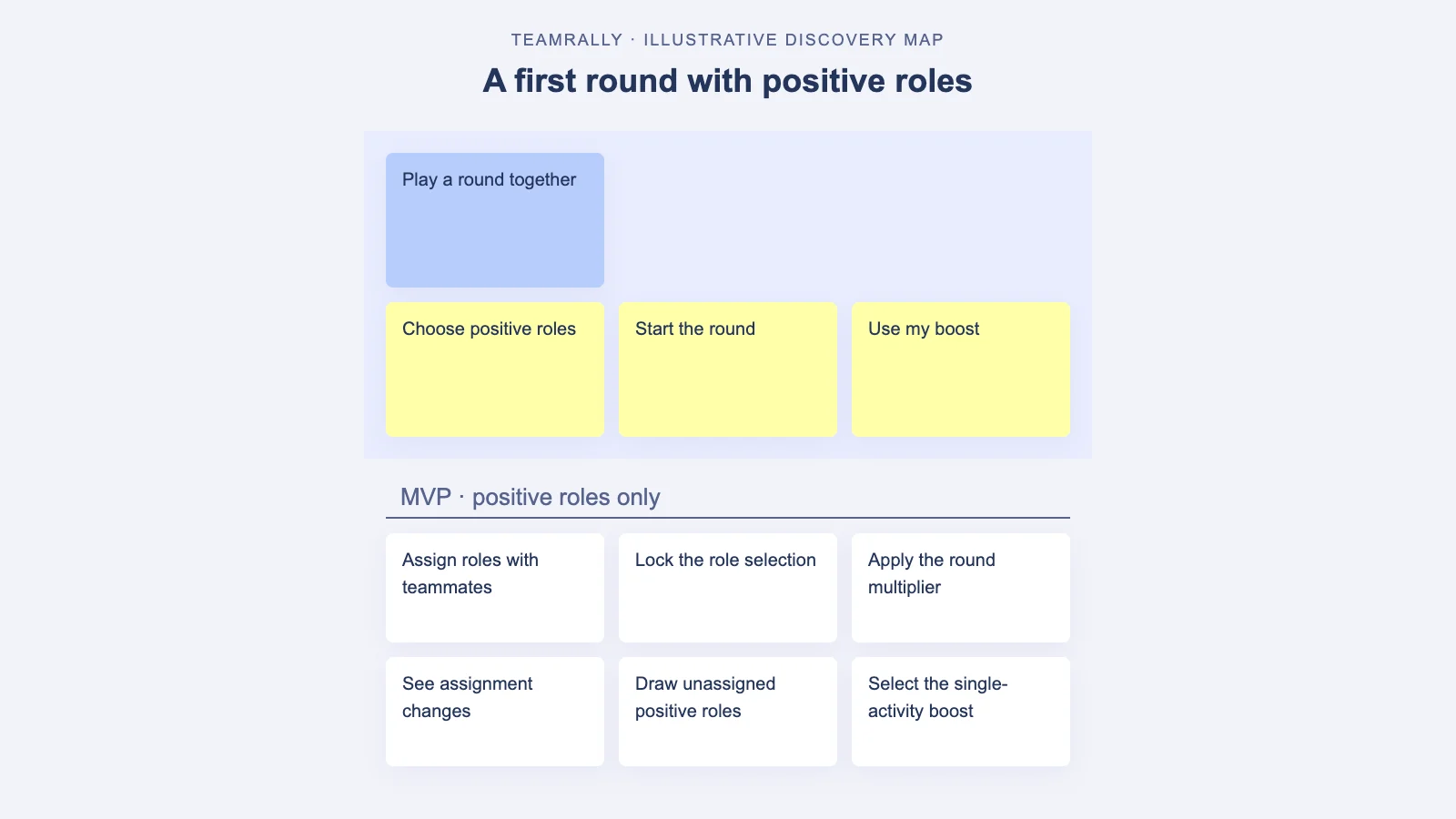
Positive roles remain: a boost for the round or a boost for one activity. Teammates can assign roles before the round, see changes, and adjust the selection until it locks. Unassigned positive roles are drawn from eligible teammates when the round starts.
The map follows that small journey. It includes the unglamorous lock and fallback behavior that makes “choose roles” usable.
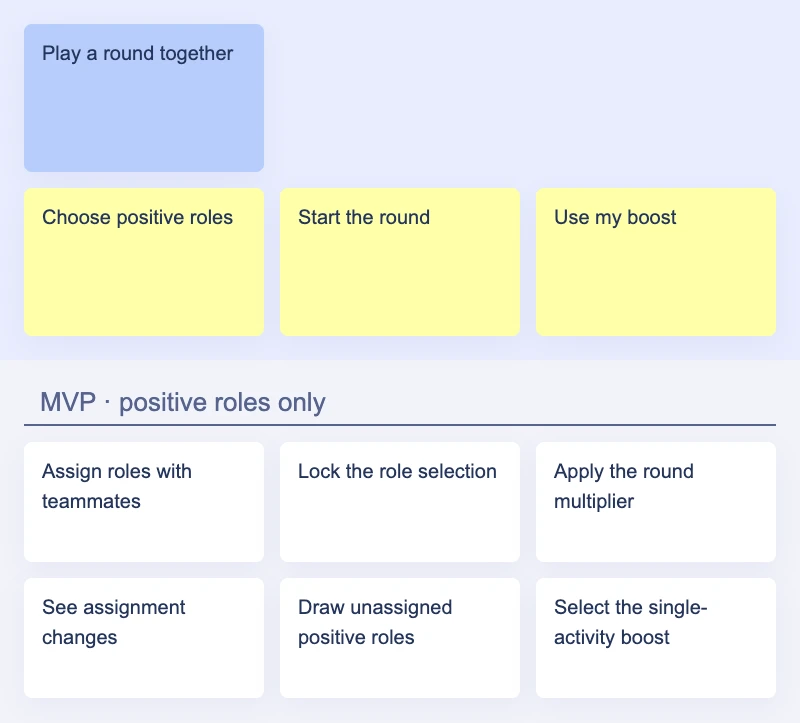
The single-activity boost also needs a decision: the participant explicitly selects the activity. It is not silently attached to the first or highest-scoring entry. That detail changes what the user must be able to do.
Give the agent an explicit boundary
This is how I would frame the handoff: “Map positive roles for the first release. Negative roles are intentionally deferred; record the unresolved fairness questions.”
That context matters when using a gap-finder skill. Otherwise, an absent penalty flow can look like missing coverage. A good MVP slice needs both a working journey and clear reasons for what it leaves out.
The creator can propose the slice, and the refiner can make locking and assignment testable. StoriesOnBoard MCP provides the board connection; the skill workflow provides proposal, approval, and read-back checks. None of those steps can decide whether a penalty feels fair on my behalf.
That is why I like this example. The useful output is a smaller first release with an explained boundary. Together with the individual-leaderboard question, it keeps the product’s team promise visible.
Before adding a game mechanic, ask the agent: who bears its cost, and what happens when nobody volunteers?