
Most teams can ship a minimal set of features; far fewer can ship a minimal set of results. The difference becomes obvious in the first week after launch: a feature-scoped MVP may look finished but still miss the mark, while an outcome-first approach ties every slice of work to a measurable shift in user behavior or business value. Making that leap—from output to outcomes—calls for new habits, tighter framing, and better tools. StoriesOnBoard brings those pieces together with collaborative story mapping, AI-assisted writing, and a planning layer that keeps releases, OKRs, and dependencies connected from discovery through delivery.
In this article, we’ll contrast conventional, feature-scoped MVPs with an outcome-first strategy grounded in jobs-to-be-done and measurable signals of progress. You’ll see how to use StoriesOnBoard to anchor on outcomes, tap AI to propose outcome-aligned stories, and rely on StoriesOnBoard MCP to weave releases, OKRs, and dependencies into a cohesive, testable MVP roadmap. By the end, you’ll be ready to ship the smallest thing that matters—an MVP that proves value, not just delivers code.
The problem with feature-scoped MVPs
- They begin with solutions instead of the customer’s job-to-be-done, turning the MVP into a feature guess rather than an outcome bet.
- Success is fuzzy or measured by proxies (e.g., on-time delivery, feature parity), which says little about user impact.
- Scope swells quickly: when “feature” equals “value,” every edge case feels critical, and creep disguises itself as completeness.
- Handoffs multiply: strategy lives in slides while engineering lives in tickets; the big picture blurs and misalignment grows.
- Learning slows: releases are sized for delivery convenience, not for the fastest path to validated learning.
- Post-launch decisions stall because outcomes aren’t tied to the original intent. Without a testable hypothesis, results are ambiguous.
What makes an outcome-driven MVP different?
An outcome-driven MVP treats a release as a hypothesis about behavior, not a bundle of features. Work starts with a clear view of who the user is, the job they’re trying to accomplish, and the outcome that job implies. Instead of asking, “What can we build fast?” the team asks, “What’s the smallest change that will show we’re moving the needle?”
This approach forces measurable success definitions up front. You name leading indicators—activation rate, time-to-value, task completion, error reduction—and design the thinnest slices that could credibly move those signals. Features become instruments for learning, not the finish line.
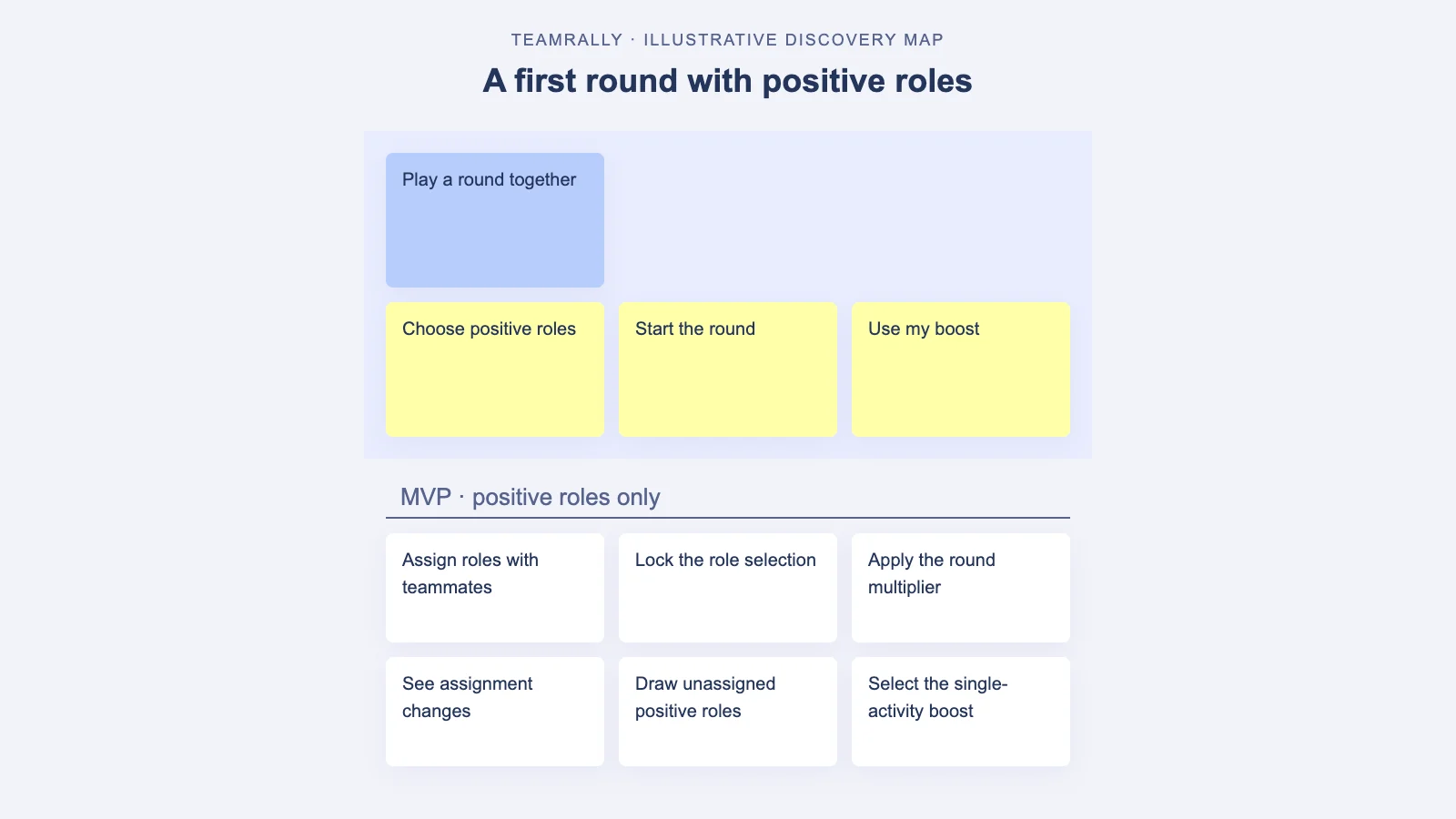
In practice, an outcome-driven MVP needs visibility across the entire journey. You must see the story end-to-end to slice well. That’s why user story mapping is essential: it preserves the narrative from high-level goals down to individual stories and makes tradeoffs and dependencies visible at a glance. StoriesOnBoard is built for exactly this—keeping conversations anchored on outcomes and helping you slice a realistic MVP that tests the riskiest assumptions first.
Principles to anchor on outcomes
- Start with a job-to-be-done statement that captures context, struggle, and desired progress. Use it as the north star when cutting scope.
- Choose one primary outcome metric and two to three supporting signals. Ensure they’re observable within the MVP window.
- Map the end-to-end journey. Organize work into goals (activities), steps, and stories to spot gaps and prevent over-investing in the wrong places.
- Slice by risk and learning potential, not by back-end module or UI surface. Pick slices that unlock real-world feedback quickly.
- Write hypotheses for each slice: “If we ship X for users in Y context, we expect Z metric to change by N%.”
- Plan instrumentation early: track the events that will confirm or refute your hypotheses from day one.
Design your outcome-driven MVP with story mapping
User story mapping reveals your product’s narrative arc: the activities users perform, the steps within each activity, and the stories that bring those steps to life. In StoriesOnBoard, this becomes a visual map where goals sit on the top row, steps on the second, and stories fill the grid below. The result is a living canvas for discovery and planning.
To craft an outcome-driven MVP, label goals and steps with the outcomes they serve. If your outcome is “Increase activation rate,” early steps might emphasize clear value, frictionless setup, and quick first success. StoriesOnBoard’s modern visual text editor lets you annotate goals and stories with hypotheses, research notes, and acceptance criteria, while live presence shows who’s editing—so conversations stay grounded and collaborative.
With the whole journey visible, over-investment stands out: maybe you’ve written five onboarding-polish stories but none that guide first use. The map makes that imbalance obvious and helps you trim or redirect effort to the slices that most directly drive your outcome.
A step-by-step path in StoriesOnBoard
- Frame the job-to-be-done: Capture user context, struggle, and desired progress in the map description to align the team.
- Define success: Add a top-level note with your primary metric (e.g., activation within 24 hours) and supporting signals.
- Create goals and steps: Lay out activities and steps across the top rows to visualize the journey from discovery to value.
- Draft user stories: Under each step, write lean stories with clear acceptance criteria. Keep them thin until slices take shape.
- Tag outcomes: Label stories that directly influence your chosen metrics. Filtering for an MVP slice becomes trivial.
- Slice the MVP: Group a minimal path through the steps that can drive measurable impact. Skip gold-plating; prioritize learning.
- Instrument the slice: Add acceptance criteria for analytics events and signals so you can judge outcomes post-release.
- Plan releases: Use StoriesOnBoard MCP to cluster stories into testable releases aligned to OKRs and surface dependencies.
- Sync with delivery: Connect to GitHub to create and sync issues from selected stories, keeping the story map as the source of truth.
- Review and refine: In grooming sessions, use filters and labels to keep outcome-critical work front and center while deferring nice-to-haves.
Use AI to propose outcome-aligned stories
Clarity accelerates; ambiguity drags. StoriesOnBoard’s built-in AI helps teams move faster by turning fuzzy ideas into structured, outcome-aligned stories and acceptance criteria. Describe your target outcome, user, and context, and the AI can propose candidate stories mapped to your journey steps and suggest thin slices testable within a single sprint.
Because the AI works inside your map, its suggestions respect the big picture. It can enrich acceptance criteria with the instrumentation events needed to measure success, or draft experiment variants (A/B flows, copy alternatives) tied directly to your hypotheses. You stay in control: edit, merge, or discard suggestions in the flexible editor while teammates watch live. The result is a backlog that’s well-formed and explicitly connected to outcomes.
Give AI better context than a flat backlog
If your AI suggestions sometimes miss the mark, the issue is often inputs. Learn why a structured story map gives AI better Context than a flat backlog, leading to clearer stories, stronger acceptance criteria, and faster learning.
Example: mapping a subscription onboarding
- Goal: Discover value
- Step: Land on homepage
- Story: Show a concise value prop with JTBD-focused copy and social proof
- Story: Provide an interactive product tour preview
- Step: Choose plan
- Story: Present a 2-plan choice with clear differences and transparent pricing
- Story: Offer a trial with credit card optional
- Step: Land on homepage
- Goal: Get started fast
- Step: Account creation
- Story: Single-field signup using an email magic link
- Story: Progressive profile collection after the first value moment
- Step: First task success
- Story: Guided checklist that leads to a first successful task completion
- Story: Contextual tips based on the selected job-to-be-done
- Step: Account creation
- Goal: See ongoing value
- Step: Usage reminder
- Story: Weekly email nudges tied to JTBD progress
- Story: In-app progress meter toward the desired outcome
- Step: Payment conversion
- Story: Timely trial-to-paid prompt after first success
- Story: Clear ROI calculator on the upgrade screen
- Step: Usage reminder
For an outcome like “increase activation rate from 35% to 50%,” an outcome-driven MVP might include just the plan-choice simplification, magic link signup, and the guided checklist stories. Everything else stays on the map for later slices. Crucially, the acceptance criteria would specify the events to track—plan click, signup completed, first task completed within 24 hours—so the team can read outcomes, not guesses.
From story map to outcome-driven MVP roadmap with StoriesOnBoard MCP
Good slicing creates options, but options need structure to become a plan. StoriesOnBoard MCP provides that structure by tying your story map to OKRs, releases, and dependencies in one view. Instead of treating your MVP as a single milestone, MCP frames it as a sequence of testable bets. Each release in the MVP roadmap states its target outcome, the stories that serve it, the dependencies that gate it, and the measurement plan that validates it.
When the team updates the map—adds a story, adjusts a slice—MCP keeps the roadmap coherent. It surfaces risk early: if a critical story relies on a third-party integration, MCP makes that dependency visible so you can resolve it or adjust the slice before sprint planning. Paired with the map, MCP becomes a control center for outcome-first execution: clear goals, clear bets, clear measures.
Plan thinner releases with AI slicing
Want a deeper dive into how to cut slices that learn fast without bloating scope? This guide shows how story maps plus AI surface dependencies, keep hypotheses crisp, and help teams plan releases while preserving product judgment.
How MCP stitches OKRs, releases, and dependencies
- OKR alignment: Link stories and releases to specific objectives and key results so every task ladders up to a measurable goal.
- Release scaffolding: Group minimal slices into named releases that spell out hypotheses, target metrics, and success criteria.
- Dependency graph: Flag cross-team and technical dependencies early to avoid surprises that derail thin, time-boxed experiments.
- Capacity-aware planning: Balance slices against team capacity so the learning cadence stays predictable and frequent.
- Risk register: Highlight high-uncertainty stories with labels, prompting experiments or spikes before commitment.
- Retrospective loop: Attach outcome data to each release to inform the next slice—double down, pivot, or retire the idea.
Collaborate without losing the big picture
Discovery and delivery often drift because teams collaborate in fragments. StoriesOnBoard pulls collaboration back to the map and roadmap, with live presence showing who’s editing and where. The modern visual text editor encourages rich, structured notes: problem statements, JTBD quotes, non-goals, and crisp acceptance criteria. With stakeholders sharing the same canvas, conversations shift from opinions to visible tradeoffs on the map.
When it’s time to execute, connect StoriesOnBoard to GitHub. Import existing issues, map them to stories, and sync updates in both directions. Filters and labels make it easy to view just the MVP slice or outcome-critical stories, maintaining focus while preserving the broader narrative. The story map remains the source of truth; tickets are the execution layer—cleanly bridged, never divorced.
Metrics that validate outcomes
- Activation: Percentage of new accounts that complete the first key task within 24 hours.
- Time-to-value: Median time from signup to the first success event.
- Task completion rate: Percentage of users who complete the core JTBD pathway on their first attempt.
- Drop-off points: Step-level abandonment on the story map to guide the next slice.
- Support load: Changes in support tickets tied to mapped steps, indicating friction or clarity gains.
- North-star proxy: For later slices, a stand-in for long-term value (e.g., weekly active usage of the primary job).
Anti-patterns and how to avoid them
Don’t let outcomes become slogans. “Delight users” is unmeasurable; “increase activation to 50%” is testable. Another trap is slicing by component. Shipping a back-end service without a front-end path to value won’t validate your hypothesis. A third is postponing instrumentation; if you can’t measure impact, you can’t learn. StoriesOnBoard helps you avoid these: keep the map journey-centered, attach metrics to releases in MCP, and bake analytics events into acceptance criteria from the start.
Also, resist stacking “must-haves” just because they’re easy to build. Ask: which single change, if true, would most improve the outcome? If you don’t know, your next slice is an experiment to find out—not a bigger feature batch.
Workshop checklist for kickoff
- State the primary job-to-be-done in real user language from research.
- Pick one primary outcome metric and 2–3 supporting signals that can move within a sprint or two.
- Map the end-to-end journey: goals, steps, and draft stories with acceptance criteria.
- Label outcome-critical stories and identify the thinnest slice that touches each essential step.
- Draft slice-level hypotheses and the analytics events needed to validate them.
- Create an MVP release in StoriesOnBoard MCP aligned to a specific OKR.
- List dependencies and risks; assign owners and mitigation experiments.
- Sync the slice to GitHub, confirming labels and two-way updates.
- Schedule a mid-sprint learning review focused on signals, not status.
Slicing strategies for learning fast
Great slices feel almost uncomfortably small—that’s the point. An effective slice stands alone, teaches you something pivotal about your outcome, and can ship without the rest of the feature iceberg. Try contrast-based slices: launch a minimal guided checklist against an existing help doc to see which reduces time-to-value. Or time-boxed slices: run a 7-day experiment targeting plan-selection clarity and compare activation before and after.
StoriesOnBoard supports these strategies by making slices concrete and visible. Cluster stories under a release, annotate the hypothesis, and ensure acceptance criteria include the right telemetry. If a slice can’t fit into a sprint, that’s a signal to cut further or reorder dependencies. Momentum comes from decisions, not from big-bang deliveries.
When to ship vs. when to simulate
- Simulate when risk is high and implementation is heavy (e.g., fake-door tests for new navigation).
- Ship when the smallest build yields authentic usage data (e.g., magic link signup to test friction reduction).
- Prototype in high fidelity when copy, layout, or flow comprehension is the bottleneck.
- Dogfood internally when edge-case risk is unknown but your team mirrors the user context.
- Use A/B toggles when you need controlled comparisons for a single metric like activation.
Run experiments inside your outcome-driven MVP
Experimentation isn’t a side quest—it powers an outcome-driven MVP. Each release is a bet on behavior change with clear success criteria. In StoriesOnBoard, document your experiment design next to the stories so engineering and product share the same language. The AI can suggest alternate flows, copy variants, or acceptance criteria that make the experiment more robust without inflating the slice.
When results arrive, attach them to the release in MCP. A win suggests expanding or scaling the slice; a neutral or negative result prompts a pivot, a deeper look at the story map for alternate paths, or a stop decision. Either way, uncertainty turns into knowledge—and knowledge into action.
Bridging planning and execution with GitHub
- Two-way sync: Keep user stories and GitHub issues aligned so engineering progress reflects planning intent.
- Label-driven focus: Filter issues by outcome labels to give squads a crisp target for the current slice.
- Acceptance criteria fidelity: Push criteria directly into issues to preserve testability and instrumentation tasks.
- Source of truth: Let the story map carry the narrative while GitHub manages execution tracks, avoiding duplication and drift.
- Release traceability: Tie commits and pull requests back to the stories and releases that serve your OKRs.
Summary: ship outcomes, not just output
Feature-scoped MVPs can confuse motion with progress. An outcome-driven MVP aims for validated learning and measurable change, tying every slice to the job-to-be-done and the signals that prove value. Story mapping reveals the end-to-end journey so you can cut confidently. StoriesOnBoard’s AI accelerates the path from ideas to well-formed stories and thin, testable slices. And with StoriesOnBoard MCP, your MVP becomes a structured roadmap of experiments aligned to OKRs, releases, and dependencies—ready for rapid execution and honest feedback.
Build the smallest thing that matters. Let your story map be the shared language, your AI a drafting partner, your MCP roadmap the spine, and your metrics the compass. With that system in place, you’ll ship less, learn more, and deliver outcomes that last.
FAQ: Outcome-Driven MVPs With StoriesOnBoard
What does an outcome-driven MVP mean in practice?
It treats a release as a hypothesis about behavior, not a feature bundle. You define a clear job-to-be-done, pick measurable indicators, and ship the smallest slice likely to move those metrics.
How do I pick the right MVP metrics?
Select a primary metric you can observe within the MVP timeframe—such as activation or time-to-value—plus 2–3 supporting signals. Ensure each story or slice is designed to credibly influence these metrics.