Most teams can recite the minimum viable product playbook by heart: clarify the problem, write a hypothesis, reduce scope to the bone, and validate with real users. It sounds simple. Yet in practice, MVPs often sprawl, skip critical steps in the user journey, or fail to tell a coherent story stakeholders can rally around. The result is a familiar blend of rework, scope churn, and delayed learning.
There’s a better way to arrive at the smallest valuable slice: treat your product as a narrative and organize discovery around the user’s goal-oriented flow. This is where story mapping shines, and where modern tools like StoriesOnBoard bring that narrative to life with collaborative visuals and built-in AI. Even better, StoriesOnBoard MCP transforms those slices into an executable plan with milestones, dependencies, and measurable outcomes—bridging the gap from strategy to delivery.
In this article, we’ll outline the classic MVP creation process, contrast it with story mapping, and then show how StoriesOnBoard AI and MCP accelerate everything from persona generation and user stories to planning and validation. Along the way, we’ll share a practical workshop flow, collaboration tips, and outcome-centric tactics to help your team build less and learn more—faster.
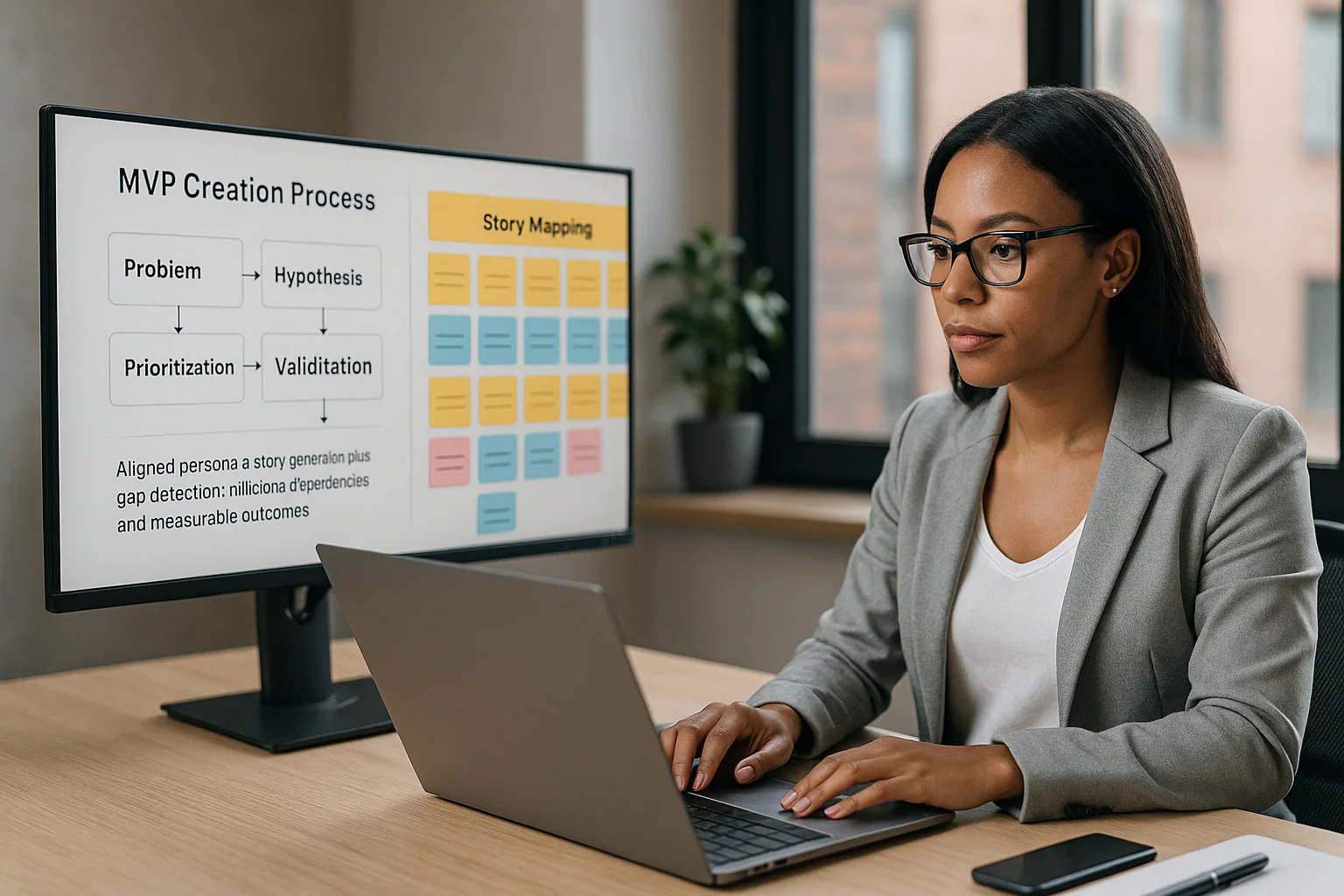
What Most Teams Do: The Classic MVP Creation Process
-
Problem framing
- Define the audience and the pain: Who struggles and why does it matter now?
- Capture constraints and success signals: What would a meaningful improvement look like?
- Identify must-have contexts: mobile vs. desktop, regulated environments, or connectivity limits.
-
Hypothesis formation
- Translate the problem into a falsifiable statement (e.g., “If we enable X, we expect Y metric to improve by Z% for segment A”).
- List assumptions: behavioral, technical, and market-related.
- Sketch experiments: prototype tests, concierge trials, or limited releases.
-
Prioritization
- Score opportunities by impact, confidence, and effort.
- Trim features to bare essentials, often by relying on lists or spreadsheets.
- Sequence work based on resource availability and risk reduction.
-
Validation
- Ship a small build or a prototype to a representative audience.
- Measure outcomes vs. expectations, collect qualitative feedback.
- Decide to persevere, pivot, or pause.
These steps are solid. Many successful products began this way. But the friction appears between bullet points—where teams struggle to see the end-to-end user experience and lose track of what truly needs to be in the first slice. Lists don’t capture stories. That’s the crux.
Why Good MVPs Still Miss the Mark
Even a well-intended MVP can bloat. We frontload “must-haves,” then realize late in the sprint that we forgot an essential step in the journey, like sign-up confirmation, error recovery, or basic reporting that allows us to measure outcomes. Each omission creates a scramble, expanding scope or forcing trade-offs that erode the learning objective.
Another common issue: teams treat discovery as a linear checklist. In reality, products are nonlinear narratives comprising goals, steps, and interactions. Without that narrative view, teams prune the backlog horizontally (by component or area) rather than vertically (by user goal). That’s how half-built flows sneak into MVPs and fail users at the moment of truth.
Finally, stakeholders often talk past one another because there’s no shared visual. Product managers, UX, and engineering need to see the same map to align on what to build and why. Without that visual source of truth, meetings devolve into opinions. Clarity suffers. So does velocity.
MVP story mapping 101: See the Product as a Narrative
-
Organize by user goals (activities)
- Start with the high-level outcomes users pursue (e.g., “Discover,” “Decide,” “Purchase,” “Onboard”).
- These become the top row of your story map—your product’s spine.
-
Break goals into user steps
- Outline the sequence a user follows to achieve each goal.
- Capture happy paths and alternatives; include preconditions and follow-ups.
-
Detail user stories beneath each step
- Write stories from the user’s perspective with clear acceptance criteria.
- Group related stories to see dependencies and potential gaps.
-
Slice vertically for the smallest valuable outcome
- Choose a thin end-to-end path that proves your hypothesis.
- Avoid partial flows; ensure instrumentation for measurement is included.
-
Iterate quickly
- Refine wording, merge duplicates, and prune scope while preserving the narrative.
- Use the map to communicate trade-offs clearly to stakeholders.
Story mapping reframes planning from “Which features first?” to “Which user journey must work first?” That shift alone reduces waste. Instead of scattering effort across subsystems, you create a coherent slice that users can complete—and that you can measure.
Give AI Better Context With Your Map
AI quality hinges on the structure you feed it. A story map gives your team a shared spine of activities, steps, and stories that AI can reason over, producing clearer personas, slices, and acceptance criteria.
For a deeper dive into why a story map beats a flat backlog for AI, read more about Context.
From Hypotheses to Slices: MVP story mapping in Action
Imagine you’re building a B2B dashboard that helps operations teams spot and resolve anomalies. Your hypothesis: if supervisors can configure alerts and triage spikes in under five minutes, time-to-resolution will drop by 30% for high-severity incidents.
With a story map, you’d first define the activities: Configure, Monitor, Triage, Resolve, and Review. Next, you’d map the steps for each activity and capture the key stories underneath. The MVP slice might be a thin, end-to-end flow: create a basic alert, trigger it with sample data, surface the alert in a prioritized feed, assign it, comment, and mark as resolved. Crucially, you’d include basic audit and timing metrics so you can verify the five-minute target and the reduction in resolution time.
Because the story map makes dependencies visible, you catch hidden work—permissions, error messaging, an initial notification channel—before the sprint starts. You also deprioritize anything not needed for the first learning objective, such as multi-tenant configuration or custom analytics. Everyone sees the same slice, agrees on outcomes, and commits.
Accelerating Discovery With StoriesOnBoard AI for MVP story mapping
-
Personas in minutes, aligned to goals
Seed StoriesOnBoard AI with your domain, segments, and a couple of example goals. The AI suggests draft personas with motivations, pains, and context-of-use details that map naturally to activities and steps. You keep control: accept, refine tone and depth, or merge personas as your understanding matures.
-
Structured user stories and acceptance criteria
Turn raw ideas into well-formed user stories with clear acceptance criteria. StoriesOnBoard’s built-in AI helps you establish consistent phrasing, add edge cases, and articulate success signals. This standardization shortens refinement cycles and creates a shared language across PM, UX, and engineering.
-
AI-assisted gap detection across the journey
As you lay out activities, steps, and stories, AI highlights likely omissions—prerequisites, recovery paths, and follow-ups that often get missed in lists. It nudges you to include key instrumentation or error handling so your MVP slice is genuinely end-to-end and measurable.
-
Faster workshop facilitation
During discovery and kickoff workshops, AI can transform sticky-note ideas into structured items on the map. With live presence indicators and a modern visual text editor, everyone co-edits smoothly while AI keeps wording crisp and the hierarchy coherent.
-
Backlog hygiene at scale
Stories grow fast. AI helps de-duplicate, consolidate similar items, and tag stories by persona or risk. The result is a lean, navigable map that stays a reliable source of truth as you iterate.
AI doesn’t replace product judgment; it removes the mechanical friction that bogs down discovery. You spend less time wordsmithing and more time deciding which slice will prove or disprove your hypothesis.
Turning Slices Into Plans With StoriesOnBoard MCP for MVP story mapping
Discovery creates clarity. Execution creates value. StoriesOnBoard MCP connects the two by converting your chosen slices into a living, executable MVP plan—so you can deliver confidently while keeping learning front and center.
Milestones you can actually ship
Map each slice to a milestone representing a tangible user outcome. MCP helps you define the scope for that milestone, set the target release window, and keep all related stories, acceptance criteria, and measures in one place. Because milestones reflect vertical slices, they’re shippable—and valuable—on their own.
Dependencies you can see and manage
Nothing derails momentum like hidden dependencies. MCP visualizes relationships across activities and steps so you can stage enabling work without breaking the slice. Whether it’s authentication, data ingestion, or a basic admin setting, dependencies are explicit and planned.
Measurable outcomes, not just output
Each milestone includes success metrics tied to your hypothesis: conversion, completion time, error rate, or qualitative satisfaction. MCP keeps these measures visible so trade-offs don’t accidentally cut your ability to learn. When you sync with delivery tools like GitHub, measures travel with the work, preserving the why behind every story.
A Practical Workshop Flow Using StoriesOnBoard
- Kickoff with a problem frame: Bring the audience, pains, and desired outcomes. Open a new story map and create top-row activities.
- Generate or refine personas with AI: Ask StoriesOnBoard AI for draft personas aligned to your domain. Edit to reflect your market and constraints.
- Map user steps: As a team, lay out the sequence for each activity. Capture alternatives where they matter.
- Draft stories with acceptance criteria: Use AI to convert notes to consistent stories. Tag by persona and risk.
- Spot gaps: Let AI flag missing prerequisites or recovery steps. Add instrumentation stories so learning is built in.
- Slice the MVP: Choose the thinnest end-to-end path that proves your hypothesis. Confirm it includes measurement.
- Create MCP milestones: Convert the slice into a milestone with dependencies, owners, and success metrics.
- Sync to delivery: Push the milestone and stories to GitHub, linking labels so the story map remains the source of truth.
- Review and iterate: After each increment, capture insights on the map. Adjust personas, steps, or scope accordingly.
This flow keeps workshops focused and energetic. People see progress in real time, and the artifact you create is immediately usable for planning and execution.
Prioritization Without Losing the Plot
When your backlog lives inside a story map, prioritization stays anchored to the journey. You can score stories by impact and confidence while still viewing their place in the flow. That context protects you from accidental scope cuts that break end-to-end value. If a story looks expensive, you don’t just drop it—you find an alternative path that preserves the slice’s integrity.
Dependencies also become more negotiable when everyone can see them. Maybe a complex settings screen can be replaced with a sensible default for the first milestone. Or perhaps a fragile integration can be simulated during validation. The map makes these trade-offs concrete and collaborative, reducing the need for lengthy explanations and slide decks.
Measuring What Matters: Outcomes Over Output
-
Define a single, primary outcome for each slice
- Example: “Reduce alert triage time from 12 minutes to 7 minutes for supervisors in Region A.”
-
Instrument the journey, not just the feature
- Track completion rates across steps and record drop-off points.
- Pair quant with structured qualitative notes from usability sessions.
-
Make metrics visible in MCP
- Attach KPIs to milestones; review them in standups and stakeholder updates.
- Use labels and filters so GitHub issues reflect the same outcomes.
-
Close the loop
- Archive learnings on the map next to the slice. Update personas or steps to reflect new insights.
- Refine the next slice based on what you actually observed—not what you assumed.
When outcomes govern scope, your “minimum” remains strategic. You resist the temptation to pack in extras because you’re shipping a testable story, not a component sampler.
Collaboration that Feels Natural
Great collaboration is about immediacy and clarity. With live presence indicators, teammates see who’s editing what. The modern visual text editor supports headings, bullets, and inline detail without friction, so you can capture nuance quickly during workshops. Because StoriesOnBoard centers on the hierarchy of activities, steps, and stories, the conversation naturally stays anchored to user goals rather than drifting into implementation details prematurely.
Stakeholders who rarely read long docs will scan a story map. They can understand decisions at a glance: which activities are in scope, how the MVP slice flows, and what outcomes define success. Fewer meetings, fewer misunderstandings, more momentum.
Integrations: Bridge Strategy and Code
-
Sync with GitHub
- Import and sync issues to keep planning and execution aligned.
- Filter by labels so engineers see exactly what’s part of the current slice or milestone.
-
Keep the map as the source of truth
- Link acceptance criteria directly from stories, ensuring the “why” travels with every ticket.
- Reflect delivery progress back onto the map to show how close you are to shipping the milestone.
-
Reduce handoff risk
- Because planning and execution speak the same language, fewer details get lost between PM/UX and engineering.
- Dependencies and outcomes remain visible after the sync, avoiding last-minute surprises.
Integration isn’t just convenience—it’s discipline.
From Map to Better Development Handoffs
Once your slice is defined, translate it into crisp tickets without losing intent. Align fields, acceptance criteria, and review points so engineering picks up exactly what users need.
See how agents streamline development Handoff from story maps into GitHub-ready work.
It ensures your MVP stays a coherent story from kickoff through release.
Common Pitfalls and How to Avoid Them
Cutting horizontally. Trimming by component creates partial experiences. Slice vertically through the story so users can complete a goal. Use the map to confirm each step exists, even if it’s simplified for the first release.
Skipping measurement. It’s easy to drop analytics when timelines tighten. Bake instrumentation into the slice from the start and track metrics within MCP so they’re first-class citizens, not afterthoughts.
Persona drift. As scopes evolve, personas blur. Revisit them in StoriesOnBoard; let AI help you re-articulate pains and contexts that matter for the next slice.
Refinement sprawl. Endless wordsmithing slows you down. Lean on AI to standardize story wording and acceptance criteria quickly, then spend your energy on trade-offs and outcomes.
Tool hopping. Decisions scatter when you juggle whiteboards, docs, and trackers. Keep discovery, slicing, and planning in one place; sync to GitHub so delivery remains connected.
Pro Tips to Scale From MVP to an MCP Roadmap
- Promote validated slices into milestones: Turn what worked into stable building blocks for the roadmap.
- Stage risk early: Use MCP to pull forward dependencies that unblock multiple slices downstream.
- Maintain rhythm: Run a lightweight discovery cadence—map, slice, measure—so you always have the next validated milestone queued.
- Guard the narrative: As you scale, keep activities and steps tidy. Merge duplicates, archive deprecated flows, and keep the story crisp.
- Keep stakeholders inside the map: Replace status slides with milestone views, dependency highlights, and outcome dashboards.
Scaling isn’t just more features; it’s more clarity. A disciplined map with MCP milestones lets your team grow without losing the thread.
Summary: Build Less, Learn More
The classic MVP playbook is sound, but it’s incomplete without a narrative view. Story mapping reframes planning around end-to-end user value, helping you choose thinner, more meaningful slices. With StoriesOnBoard, that narrative becomes a live, collaborative artifact your whole team can trust. Built-in AI accelerates personas, story writing, and gap detection, while StoriesOnBoard MCP turns validated slices into executable plans with visible milestones, managed dependencies, and measurable outcomes.
If you want to move from strategy to execution with fewer detours, embrace the map. Make your first slice a complete story, instrument it, and let outcomes guide your next step. That’s the promise of MVP story mapping done right: less rework, tighter alignment, and faster learning—start to finish.
FAQ: MVP Story Mapping with StoriesOnBoard AI and MCP
What’s the core difference between classic MVP planning and story mapping?
Story mapping organizes work around end-to-end user goals instead of component lists. It slices vertically through a complete journey, ensuring the first release is coherent, measurable, and aligned to a hypothesis.
How does StoriesOnBoard AI accelerate discovery?
It drafts personas, structures user stories with acceptance criteria, and flags gaps like prerequisites or recovery paths. You keep control to refine tone, depth, and scope while AI removes mechanical friction.
What is MCP and why does it matter?
StoriesOnBoard MCP turns validated slices into executable milestones with visible dependencies and success metrics. It keeps outcomes front and center so delivery preserves the learning objective.
How do we choose the first MVP slice?
Pick the thinnest end-to-end path that proves or falsifies your hypothesis. Include instrumentation and any minimal dependencies required so the flow is truly shippable and measurable.
How do we prevent scope creep while mapping?
Anchor prioritization to the journey, not components, and deprioritize anything not needed for the first learning goal. Use the map to reveal hidden work early and negotiate simpler defaults for initial milestones.
What does a practical workshop look like?
Start with the problem frame, then map activities, steps, and stories together. Use AI to standardize wording, tag by persona and risk, and convert the chosen slice into an MCP milestone synced to delivery tools.
How should we measure success?
Define a single primary outcome per slice, instrument the journey, and pair quant with structured qualitative notes. Keep metrics visible in MCP so trade-offs don’t cut your ability to learn.
How does GitHub integration support execution?
Sync stories and milestones so engineers see exactly what’s in the current slice via labels and linked criteria. Progress reflects back onto the map, keeping strategy and code aligned.
How does this approach improve stakeholder alignment?
The shared visual map makes scope, flows, and outcomes obvious at a glance. It reduces meetings and slide decks while focusing discussion on user goals and measurable results.
When do we scale from MVP to a roadmap?
Promote validated slices into milestones and stage cross-cutting dependencies early using MCP. Maintain a light discovery cadence—map, slice, measure—so the roadmap grows without losing the narrative.