Administrators and end users should share a story map when their actions form one coherent journey that the team needs to plan and release together. Use separate maps when their goals, workflows, ownership, or release decisions are substantially different. The number of personas alone is not a useful splitting rule.
Start from the outcome and the coordination required. “An administrator invites someone, and that person joins the right workspace” is a connected scenario. “An administrator manages annual access reviews” and “an analyst completes daily analysis” usually involve different journeys even though both belong to the same product.
The examples below use fictional B2B workspace onboarding. They show two legitimate structures for the same behavior, with the tradeoffs made explicit.
Separate the shared business outcome from individual user goals
The business wants teams to become active in a workspace. The administrator wants to bring the right people in with appropriate access. The invited analyst wants to enter the correct workspace and begin useful work. These goals overlap, but they are not identical.
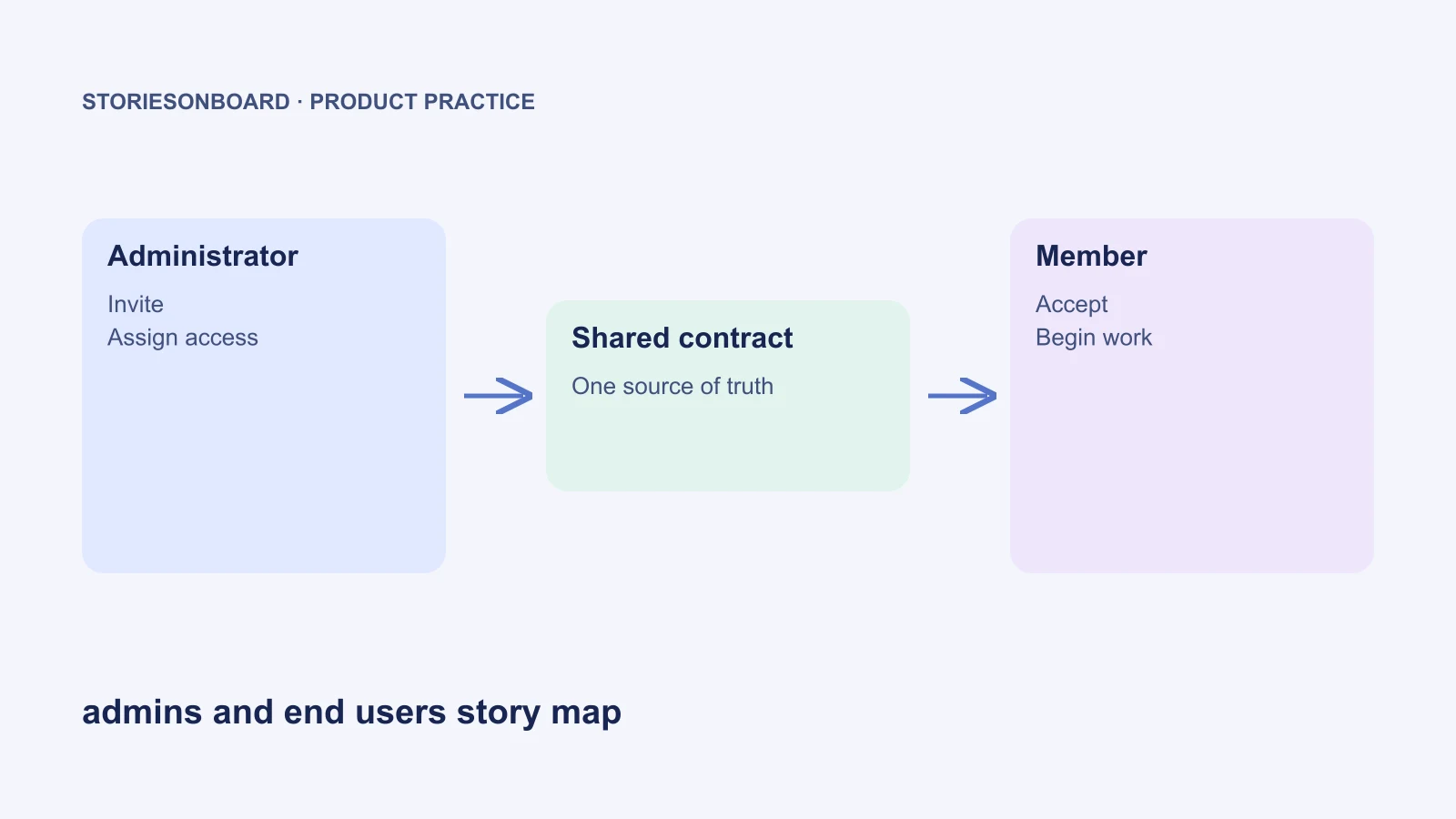
A shared map can show how the two roles coordinate across one onboarding outcome. It should still identify who performs each step and which stories belong to which role. A persona label is not a replacement for a clear task narrative.
A separate administrator map might later cover provisioning, policy configuration, offboarding, and audit review. Those are not merely additional variations of the analyst's joining journey. Extending one onboarding map indefinitely would make both planning and reading harder.
Jeff Patton's story mapping reference describes maps spanning a process across user types. That supports a shared view when the process requires it; it does not imply that every role in a product must live on one board.
Use a decision matrix before splitting
| Question | Favors one map | Favors separate maps |
|---|---|---|
| Is there one narrative outcome? | Admin invites; analyst joins; both complete onboarding. | Admin governs access; analyst performs an unrelated daily job. |
| How different are the steps? | A short handoff connects a manageable set of role-specific steps. | Most steps have no meaningful relationship to the other role's journey. |
| Who makes release decisions? | One team needs a coherent end-to-end slice. | Different teams plan independently with explicit interface commitments. |
| How much coordination is required? | Changes on one side immediately affect the other side's success. | A stable contract can connect independently evolving workflows. |
| Can people read the map? | Roles and dependencies remain understandable at the working level. | Filtering is needed merely to find the main journey among unrelated branches. |
| Will splitting duplicate decisions? | One canonical invitation policy and release boundary are easier to maintain together. | Owners can retain canonical shared requirements and link them reliably. |
Do not turn the matrix into an automatic score. One decisive constraint can outweigh several preferences. For example, a coordinated pilot may need a shared release view even when two teams own the implementation. A sensitive administrative workflow may need separate access arrangements regardless of diagram convenience.
Option A: one shared onboarding map
In the shared alternative, the map follows the handoff from preparing an invitation to joining the workspace. Role names remain in the stories, while goals describe outcomes. The release lane shows the smallest complete path for both sides.
The first slice includes creating one invitation, selecting Viewer or Editor, accepting a valid invitation, and reaching the assigned workspace. It also includes the agreed expired-link recovery needed for this scenario. Bulk administration and richer orientation are later options, not hidden prerequisites.
This view makes a common planning problem visible: shipping “Send invitation” without a usable acceptance path does not deliver the onboarding outcome. It also lets the team discuss how role choice affects what the invited person sees next.
Use role-specific descriptions and acceptance criteria. “Admin selects a role” and “Analyst understands assigned access” should not collapse into a vague “Manage roles” story. The first governs an administrative action; the second supports the recipient's understanding.
Option B: two maps with an explicit handoff
Separate maps can work when an administration team owns invitation management and a workspace team owns joining and orientation. Keep a small contract between them: invitation identity, target workspace, assigned role, lifecycle state, and the approved recovery behavior.
The administrator map stops at the invitation lifecycle boundary. The invited-user map begins with a valid or expired invitation and continues to the first useful action. Neither team should silently invent the contract on the other side.
| Shared item | Canonical owner | How both maps refer to it |
|---|---|---|
| INV-01 · Invitation state contract | Invitation service owner | Link the same requirement defining Pending, Accepted, and Expired behavior. |
| ROLE-02 · Viewer/Editor permissions | Product access-policy owner | Admin selection and member access stories reference the same policy. |
| REC-03 · Expired-link recovery | Jointly agreed product decision, one named maintainer | Both maps link the recovery decision and their own implementation stories. |
| PILOT-04 · End-to-end acceptance | Pilot release owner | A shared test verifies invitation through first workspace action. |
These IDs are illustrative references, not claims about a built-in dependency system. Use the linking and tracking mechanisms your team actually maintains. The important property is one canonical decision with clear consumers, not a particular tool feature.
Avoid duplicate stories and conflicting ownership
Two maps do not require two copies of the same implementation task. If “Validate invitation token” belongs to one service, keep one canonical work item and link the dependent user-facing stories to it. Separate the shared capability from the different outcomes it supports.
Duplicates become dangerous when they accumulate different criteria, dates, or owners. During refinement, compare shared references and resolve divergence. A map should not become a second unofficial source of truth for a requirement owned elsewhere.
Likewise, do not use a shared map to hide ownership. Put an owner on the contract and each delivery story. The map makes the coordination visible; it does not perform the coordination or guarantee that both teams will release compatible behavior.
If your existing persona setup needs improvement, review persona design for product planning. Choose persona detail that changes the journey or decision. A demographic detail with no effect on the workflow is less useful here than permission level, responsibility, or frequency of use.
Check the release slice across both roles
Whether you use one map or two, walk through the release as a scenario: an Admin prepares an invitation, the intended person receives the entry point, the person joins with the agreed access, and an expired invitation follows the agreed recovery route.
Ask what happens if only one side ships. Can an administrator create an invitation the recipient cannot use? Can the recipient enter but receive the wrong role? Can support diagnose a failure across the handoff? These questions reveal dependencies that separate team backlogs often conceal.
Keep optional improvements outside the slice unless they are required for the chosen outcome. Bulk import may be valuable, but it is not automatically necessary for a pilot built around single invitations. Conversely, a recovery path can be essential even when it is not the most common path.
The release planning guide provides broader context for coherent slices. Here the key test is whether the combined behavior serves the agreed users, not whether every team has completed an equal number of cards.
Revisit the structure when the product changes
Start with the structure that makes the next decision clear. A single onboarding map may later split when administrative governance grows into a substantial independent journey. Separate maps may need a temporary shared view for a coordinated migration or pilot.
Record why the structure was chosen and what should trigger a review: unreadable scope, repeated duplicate decisions, independent release ownership, or missed handoffs. Do not split merely because the board is wide, and do not keep everything together because it began that way.
For your next map review, trace one administrator action all the way to the end user's outcome. If that conversation is easier on one board, keep the shared map. If the journeys are independent, split them and make the handoff contract explicit.