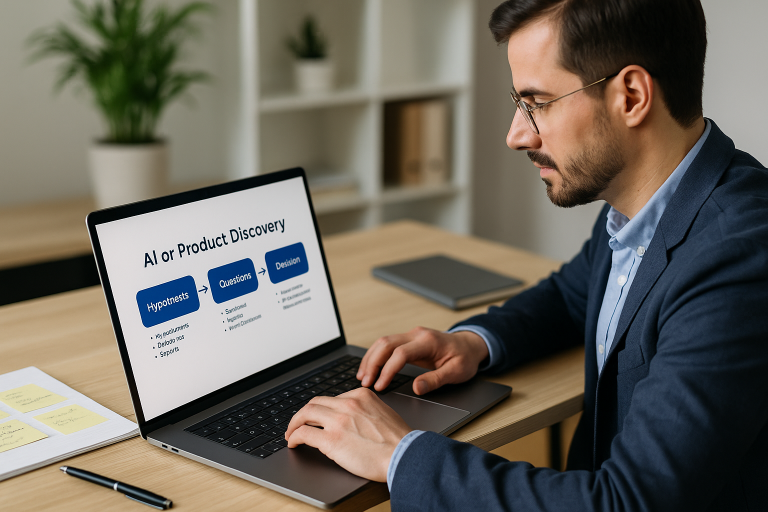
Speed matters in product discovery, but speed without learning is just motion. The right goal is faster validated learning. In this practical guide, we will use AI as a thinking partner to reduce cycle time from question to answer, while keeping human judgment, real users, and hard evidence in the driver’s seat. We will anchor every tactic in a workflow you can run inside StoriesOnBoard, so your discovery work stays connected to planning and execution.
We will explore how AI helps you generate better starting points: drafting interview guides, listing hypotheses, mapping unknowns and risks, and synthesizing notes into themes. Equally important, we will set the safeguards that make AI safe and smart: separating evidence from guesses, tagging confidence levels, and validating AI outputs with actual user input and data. By the end, you will have a lightweight discovery flow—hypothesis → questions → signals → decision—plus example prompts for each stage you can copy into your next session.
- Turn a hazy idea into a structured set of hypotheses and testable questions within minutes.
- Use AI to outline interviews, survey drafts, and assumption maps—without letting it “invent” answers.
- Tag confidence and sources so your team can see what’s known, unknown, and risky.
- Synthesize research notes into grounded themes directly in StoriesOnBoard.
- Keep your user story map as the source of truth from discovery through delivery.
What is ai-product-discovery?
ai-product-discovery is a disciplined way to apply AI to the first mile of product work: understanding problems, clarifying users and contexts, and learning which opportunities matter. It’s not about delegating decisions to a model. It’s about accelerating the tedious parts of planning and sense-making, so you can spend more time with customers and more attention on evidence.
In classic discovery, product managers juggle interviews, notes, intuition, competing stakeholder requests, and a backlog that expands faster than understanding. It’s easy to lose the thread. With AI, you can compress prep time, standardize guardrails, and surface patterns in qualitative data—all while keeping the story map as the shared picture that shows why you are building, what you are building, and in what order.
- AI accelerates the setup: draft guides, canvases, and checklists so you start faster.
- AI expands possibilities: generate alternative hypotheses you might have missed.
- AI sharpens alignment: translate messy notes into clear, tagged insights.
- Humans validate: only user input and real data move a hypothesis along the path to confidence.
Safeguards for ai-product-discovery
The most important skill in ai-product-discovery is knowing what not to trust. Treat every AI output as a first draft. Mark what is assumption versus evidence, and make validation paths explicit. This discipline turns AI from a confident storyteller into an honest collaborator.
Inside StoriesOnBoard, you can embed this discipline into your story map and backlog artifacts.
Add labels and fields that separate claims from proofs. Use confidence tags on notes, opportunities, and user stories. Keep source links and timestamps so anyone can audit where a belief came from. This combination reduces rework, prevents brittle handoffs, and helps stakeholders stay aligned on what is known, what is guessed, and what is next to learn.
- Evidence vs. guesses: Maintain two fields or tags on each insight—“Assumption” and “Evidence.” Only move items to evidence when there is a transcript excerpt, metric, or artifact to back it up.
- Confidence levels: Use low / medium / high tags with a short rationale. Confidence goes up only when the sample grows, signals are consistent, and bias is addressed.
- Traceability: Link each insight to a source—customer interview, support ticket, analytics chart, or experiment report.
- Review cadence: Schedule discovery reviews where the team challenges high-confidence claims and promotes only what survives scrutiny.
Drafting Interview Guides with ai-product-discovery
Interviews are where you trade hypotheticals for real stories. AI can help you prepare, but the best interviews are still human: curious, flexible, and grounded in the participant’s lived experience. Use AI to produce a structured guide and then refine it with your team in StoriesOnBoard’s collaborative editor. Add goals, timeboxes, key probes, and bias checks right on your story map so interviewers stay consistent while improvising intelligently.
Start with goals tied to your hypotheses. If the hypothesis is “Onboarding takes too long, causing drop-off,” your guide should explore time-to-first-value, moments of confusion, and user definitions of “done.” Ask for stories, not opinions. Sequence questions from general to specific. Add optional branches when a promising avenue appears.
- Prompt to draft a user interview guide
Context: SaaS onboarding for new project managers. Goal: Identify the steps to first value and the biggest blockers. Constraints: Avoid leading questions. Prefer story-based prompts. Output: 30-minute guide with sections (Intro, Background, Walkthrough, Probes, Wrap) and 3 bias checks. - Prompt to turn the guide into a checklist
Take this interview guide and convert it into a one-page checklist with timeboxes, must-ask questions, optional probes, and red flags to watch for. - Prompt to create bias checks
Review this guide and list 5 risks of bias or priming. Suggest a neutral rephrasing for each risky question and add a reminder to ask for specific past events.
Generating hypothesis lists and mapping unknowns and risks
Great discovery starts with a map of what you believe and what you don’t know. AI can speed this inventory. Feed it your product vision, a few stakeholder notes, and the top jobs-to-be-done you suspect. Ask it to propose hypotheses across problem, user, solution, and business viability. Then collapse, merge, and prioritize with your team. Store each hypothesis on your StoriesOnBoard map as a card with fields for evidence, confidence, and next learning step.
Unknowns and risks deserve their own lanes. Think feasibility (can we build it?), desirability (do users want it?), viability (does it make business sense?), and operational risk (can we support and sell it?). In StoriesOnBoard, create swimlanes or color labels for risk type. As interviews and experiments complete, drag cards between states and update confidence. The visual flow keeps the whole team aligned.
- Hypothesis scaffolding
- Problem: We believe [user segment] struggles with [problem] because [reason].
- Behavior: When [trigger], they currently [workaround] and feel [emotion].
- Solution: If we provide [capability], they will [desired behavior].
- Outcome: This will increase [metric] from [baseline] to [target].
- Risk and unknowns checklist
- Desirability: Is the problem acute and frequent? Who is the economic buyer?
- Usability: Can first-time users reach value in under N minutes?
- Feasibility: Any technical or integration blockers? Security and privacy concerns?
- Viability: Unit economics, pricing power, and sales cycle assumptions.
- Go-to-market: Channels, messaging fit, and onboarding friction.
- Prompt to generate hypotheses and risks
Input: Brief, target segment, top jobs-to-be-done.
Task: Propose 10 hypotheses (problem, behavior, solution, outcome). Tag each with risk type and an initial confidence (low/med/high) with a 1-sentence rationale.
Output: Table-like list suitable for import to a story map.
Synthesizing qualitative notes into themes using StoriesOnBoard AI
Transcripts and sticky notes are rich but unwieldy. AI can compress this mass into candidate themes, quotes, and contradictions. In StoriesOnBoard, paste interview notes into cards or attach files. Use the built-in AI assistant to extract recurring problems, surprising counterexamples, and lexicon—how users describe their world. Then map these themes to user goals and steps on your story map so the evidence literally sits under each part of the end-to-end narrative.
Guard against hallucination by forcing the model to cite. Ask it to show the exact excerpts that support each theme, and to mark items as “hypothesis only” when it can’t find a quote. Use confidence tags. Consolidate duplicates. Reject themes the data cannot carry. The outcome is a smaller, stronger set of insights with traceability that stakeholders can trust.
- Prompt to synthesize interviews
Input: 8 interview notes. Users: mid-market PMs adopting a story mapping tool. Task: Extract 5-8 themes with a representative quote for each. Include disconfirming evidence when present. Classify themes by risk (desirability/usability/viability) and tag confidence. Constraints: Only use direct quotes for evidence. Mark unquoted claims as assumption. - Prompt to produce opportunity statements
From these themes, craft opportunity statements in the form: "[User] needs a way to [do X] because [reason], which would improve [metric]." Include an evidence link to the source card ID. - Prompt to cluster themes onto a story map
Map these themes to a user story map with levels: Goals, Steps, Stories.
Place each theme under the step it affects. Suggest a minimal viable slice (MVP) that tests the riskiest assumptions first.
Applying AI within the StoriesOnBoard story map
Your story map is the backbone of discovery and delivery.
It shows user goals, the steps they take, and the stories you will implement. Use StoriesOnBoard to combine discovery artifacts and planning in one place, so signals flow into decisions without getting lost in handoffs. The built-in AI features help draft user stories and acceptance criteria when you are ready, but during discovery you can also use AI to polish opportunity statements, summarize a swimlane of notes, or propose alternative slices for an MVP.
StoriesOnBoard’s real-time collaboration, presence indicators, and flexible editor make co-creation fast. Invite research, design, and engineering into the same map. Tag items with confidence and evidence links. When a story matures, push it to your delivery tool—like GitHub—keeping a two-way sync and label filters so engineering can execute while product maintains context in the map as the source of truth.
- Create a “Discovery” board view in StoriesOnBoard with columns for Assumptions, Evidence, and Decisions. Use color to mark risk type.
- For each hypothesis, add a card with fields: source, confidence, validation plan, and next signal to collect.
- After each interview, paste notes into a card. Run AI summarization to extract themes with quotes. Link back to the source.
- Cluster themes under the relevant steps in your user story map. Add acceptance criteria placeholders only after the problem is validated.
- Slice an MVP by selecting the smallest set of steps that validate the riskiest assumption. Use AI to propose 2-3 alternative slices.
- When ready, export selected stories to GitHub and sync labels for confidence and risk so the learning context travels with the ticket.
Lightweight Discovery Workflow for ai-product-discovery
Here is the loop that keeps learning fast and honest. It works for a one-week spike or a multi-sprint exploration. Keep it visible in your StoriesOnBoard map and attach prompts to each stage so the team can move quickly without skipping rigor.
1) Hypothesis
Express a falsifiable belief. Place it on your map with confidence = low and an explicit risk type. Link to the assumption list generated earlier.
Prompt example (Hypothesis):
Context: We suspect onboarding takes too long.
Task: Write 5 falsifiable hypotheses across desirability, usability, and viability. Include expected signals and a kill-criterion for each.
Constraint: Keep each hypothesis under 200 characters.
2) Questions
Transform the hypothesis into questions you can ask users or answer with data. Choose formats—interview, survey, product analytics, benchmark—that fit the risk. Place the questions in your interview guide or experiment plan.
Prompt example (Questions):
Input: Hypothesis "First value takes >15 minutes for new PMs."
Task: Generate 8 non-leading interview questions and 3 neutral probes to uncover time-to-value and blockers.
Constraint: Only ask about past behavior. Avoid "would you" phrasing.
3) Signals
Define what would count as supportive or disconfirming evidence before you collect it. Signals can be time-on-task, completion rates, verbatim quotes, task success, or willingness to pay. Add the expected direction and threshold. This prevents post-hoc rationalization.
Prompt example (Signals):
Input: Hypothesis and questions above.
Task: Propose 6 measurable signals (qual + quant) with thresholds and bias checks. Label each as confirm, disconfirm, or explore.
Constraint: Use concrete numbers and explicit quote criteria.
4) Decision
Based on signals, update confidence and decide: proceed, pivot the approach, or stop and revisit the opportunity. Add the decision and rationale to the story map card. If the outcome affects the delivery backlog, update or de-scope stories and communicate the change with links to the evidence.
Prompt example (Decision):
Input: Signals observed + quotes + metrics.
Task: Summarize the learning in 150 words, update confidence, and recommend proceed/pivot/stop with a 2-bullet rationale.
Constraint: Include links to evidence and note any open risks.
Common pitfalls and how to avoid them
- Letting AI answer instead of structure: Never accept solution or problem claims without fresh user input. AI can propose, humans must validate.
- Conflating patterns with proof: A theme is not a law. Tag confidence and sample size. Seek disconfirming cases.
- Leading questions: Use bias checks. Prefer stories from the past. Replace “Would you use” with “Tell me about the last time.”
- Skipping kill-criteria: Define thresholds upfront. If unmet, stop or pivot. This preserves integrity.
- Handoffs without context: Keep discovery artifacts in StoriesOnBoard linked to delivery tools. Sync labels so decisions are visible in engineering.
- Over-slicing MVP: Remove only what is not required to test the riskiest assumption. If you remove the test, it’s no longer an MVP—it’s theater.
Measuring learning speed: signals and decision hygiene
If you can’t measure learning speed, you won’t know if AI is helping. Track time from hypothesis creation to decision. Track ratio of disconfirmed to confirmed hypotheses—progress is not just yeses. Monitor the number of insights with quotes attached versus unquoted claims. Aim for decisions grounded in tangible signals, even if the answer is “not now.”
StoriesOnBoard makes this visible. Add a “learning cycle time” field and link to the signals that drove each decision. Create a dashboard swimlane for “Decisions This Week,” each with tags for proceed, pivot, or stop. During reviews, sort by low confidence and choose the next questions deliberately. This keeps the team focused on the right unknowns—not just the easy ones.
- Cycle time: Days from hypothesis to decision. Target a steady decrease.
- Evidence coverage: Percent of insights with direct quotes or data links.
- Disconfirmation rate: Portion of hypotheses rejected—healthy teams reject liberally.
- Confidence drift: Watch for unjustified jumps in confidence without new signals.
- Decision latency: Time between signal arrival and decision update on the map.
Case vignette: Validating an onboarding assumption with StoriesOnBoard
A product team suspects new project managers abandon their tool before creating a first story map. The team spins up an ai-product-discovery sprint. In StoriesOnBoard, they add a hypothesis card: “New PMs fail to reach first value within 15 minutes.” Confidence: low. Risk: usability. They attach an initial interview guide drafted with AI, then refined by the UX lead to remove leading prompts. They define signals: time-to-first-goal under 10 minutes for 70% of new users; quotes describing confusion around map levels; or a counter-signal—users reach value fast but still leave due to integration gaps.
Interviews reveal that users can build a map in under 8 minutes, but they stall when trying to sync with GitHub. The disconfirming evidence flips the risk from usability to feasibility/integration. The team updates the story map: an opportunity under the “Connect tools” step, with an MVP slice focused on frictionless repo selection and label mapping. They use StoriesOnBoard’s AI to draft acceptance criteria and push the stories to GitHub with labels indicating risk and confidence. Within a week, they run a concierge test with five teams. The signals (reduced setup time, enthusiastic quotes, and improved sync completion) support a proceed decision. Crucially, they avoided building onboarding flows they didn’t need. They learned faster by asking better questions and following their own decision hygiene.
- Assumption reframed by evidence, not opinion.
- Confidence updated with quotes and metrics attached.
- Story map remained the source of truth across discovery and delivery.
- AI accelerated prep and synthesis, while humans validated in the field.
ai-product-discovery in cross-functional practice
ai-product-discovery shines when product, design, research, and engineering work from the same map. Designers add usability risks; engineers flag feasibility constraints; product ops tracks confidence and decision latency; PMs frame hypotheses and routes to signals. StoriesOnBoard’s live presence makes this collaboration fluid. When someone updates a card—say, a new quote from a support ticket—everyone sees the confidence tag refresh in real time. The result: fewer meetings to “sync,” more time to learn.
- PMs: Frame the hypotheses and kill-criteria; own the signals.
- Design: Shape interview probes, run usability tests, and translate themes into journeys.
- Engineering: Highlight system constraints and experiment scaffolding.
- Research: Guard the evidence quality and bias checks.
- Analytics: Attach quantitative signals and define instrumentation.
Prompts you can paste today
Here are short prompts designed to plug into your StoriesOnBoard workflow. Use them to keep momentum without sacrificing rigor.
- Convert stakeholder input into testable hypotheses
Input: 5 stakeholder requests. Task: Translate each into a testable hypothesis with risk type, confidence (low), and a primary signal to collect. - Map unknowns to a story map
Input: Opportunity statements. Task: Place each under Goals/Steps/Stories and suggest the minimal slice that tests the riskiest assumption. Include a confidence tag. - Summarize a research burst
Input: Notes from 6 short interviews. Task: Synthesize 6-8 insights with quotes, mark evidence vs. assumption, and propose 3 decisions (proceed/pivot/stop) with rationale. - Draft acceptance criteria only after validation
Input: Validated user story.
Task: Write acceptance criteria in Gherkin-style that verify the user outcome, not internal implementation. Include edge cases from research.
ai-product-discovery: when not to use it
There are moments to slow down. If the risk is ethical (privacy, safety), if users are highly regulated, or if the cost of being wrong is extreme, bias toward expert review and direct evidence before letting AI shape the frame. Use AI to document alternatives and summarize literature, not to define the problem or propose user claims. This keeps your bar high where it needs to be.
- High-stakes domains: Validate with domain experts and formal studies.
- Small, non-representative samples: Don’t generalize themes; mark them as exploratory.
- Ambiguous ownership: Decide who updates confidence and when; avoid crowd-sourced drift.
Summary and next steps
ai-product-discovery is not about outsourcing thinking. It is about using AI to start faster and learn deeper. Draft interview guides in minutes, generate broader hypothesis sets, map unknowns and risks clearly, and synthesize qualitative notes into themes with quotes. Keep strong safeguards: separate evidence from guesses, tag confidence rigorously, and make every AI output a starting point that must be validated with real user input and data. Run a lightweight loop—hypothesis → questions → signals → decision—and keep it visible in your StoriesOnBoard story map so discovery flows into delivery without losing context.
Start today: create a Discovery swimlane in StoriesOnBoard, add confidence tags, and paste the prompts above into your next session. Use the built-in AI to help with the heavy lifting, keep your sources attached, and sync validated stories to GitHub when you are ready. You will move from strategy to execution with more clarity, less rework, and faster validated learning—exactly what great product teams aim for.
FAQ: AI for Product Discovery in StoriesOnBoard
What is ai-product-discovery?
A disciplined way to apply AI to early product work—understanding problems, users, and opportunities. It speeds up planning and synthesis while keeping human judgment, real users, and evidence in charge.
Does AI replace interviews?
No. AI drafts guides, prompts, and checklists, but validation comes from real users and data. Treat every AI output as a first draft and confirm with quotes, metrics, or artifacts.
How do we prevent hallucinations?
Separate assumptions from evidence on every insight and require citations. Tag confidence (low/med/high) with rationale, link to sources, and hold regular discovery reviews to challenge claims.
Where do hypotheses live?
Store each hypothesis on your StoriesOnBoard map as a card with fields for evidence, confidence, risk type, and next learning step. Use a Discovery board with columns for Assumptions, Evidence, and Decisions to track progress.
What signals should we define?
Decide confirm/disconfirm signals before research to avoid post-hoc bias. Use concrete thresholds across qual and quant—time-to-first-value, completion rates, verbatim quotes, task success, or willingness to pay.
How do we measure learning speed?
Track cycle time from hypothesis to decision, disconfirmation rate, and evidence coverage. Monitor confidence drift and decision latency, and surface a Decisions This Week lane to keep momentum visible.
How do we slice an MVP?
Select the smallest set of steps that tests the riskiest assumption. Use AI to propose 2-3 alternative slices and avoid removing the test itself—otherwise it's theater.
How does this connect to delivery?
When a hypothesis matures, translate insights into user stories and acceptance criteria. Export selected stories to delivery tools like GitHub with two-way sync and labels for risk and confidence so context travels.
How do roles collaborate?
Work from the same story map: PMs frame hypotheses and kill-criteria, design shapes probes and tests, engineering flags feasibility, and product ops tracks confidence and latency. StoriesOnBoard live presence keeps everyone aligned.
How can we start this week?
Create a Discovery board, add top hypotheses with risks and kill-criteria, and draft interview guides with AI. Run a few interviews, synthesize themes with quotes in StoriesOnBoard, define signals, then decide to proceed, pivot, or stop.