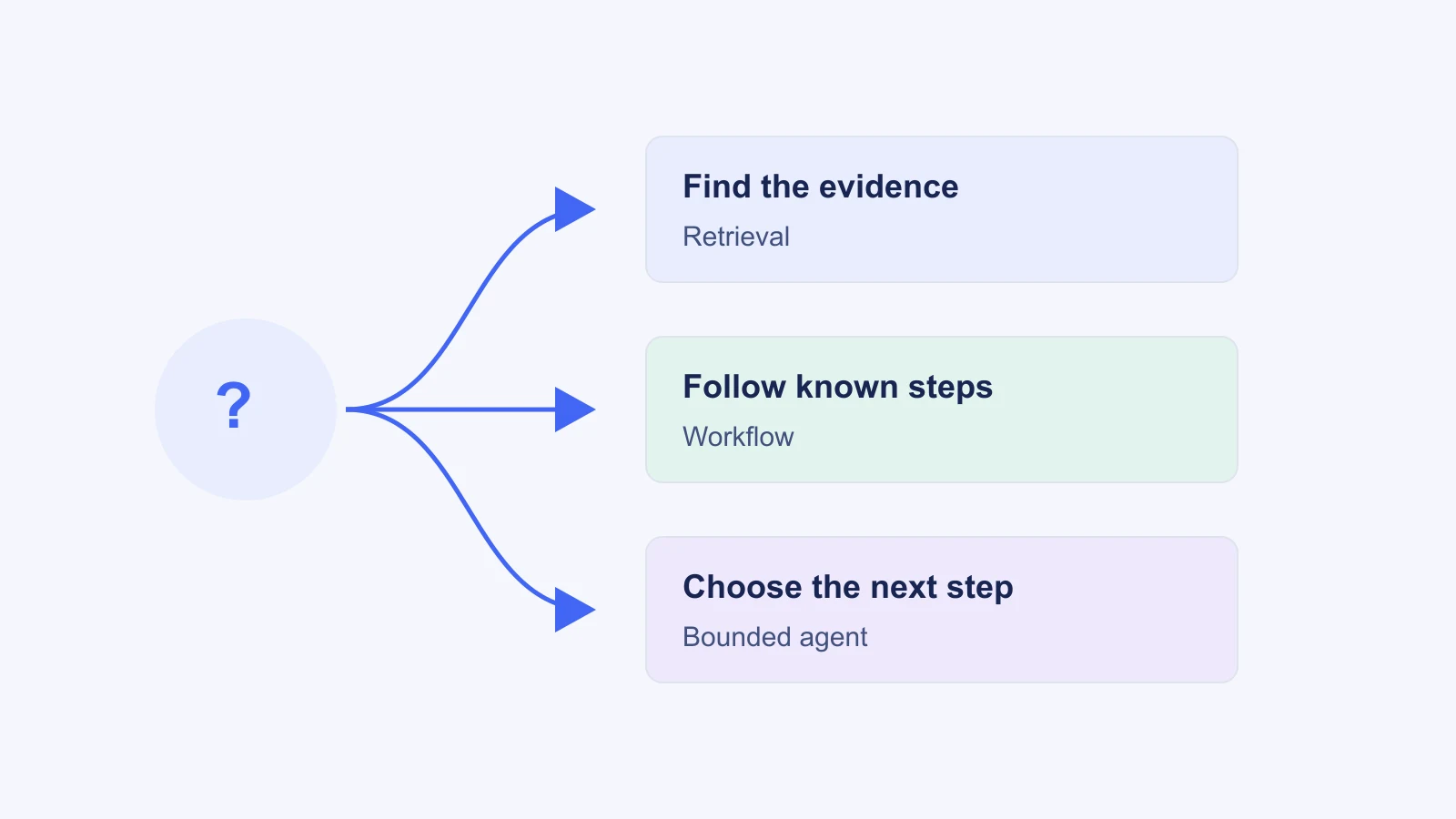
Use retrieval when the task is to answer a question from existing evidence. Use a constrained workflow when the steps and decision points can be specified in advance. Consider an agent when the system must choose its next action based on what it discovers, and when you can bound, observe, and evaluate that freedom.
These approaches can coexist. An agent may retrieve documents, and a workflow may use a language model at several steps. The practical decision is how much control over the sequence of work belongs to the application and how much belongs to the model.
For a Product Owner or Product Builder, the starting question is therefore specific: what must this task accomplish, and what decisions can safely remain open while it runs? This guide compares retrieval, constrained workflows, and AI agents using the same fictional invitation feature and product records.
Define the three options in operational terms
Retrieval-assisted answering selects relevant information and uses it to answer a question. Its useful output is an answer with evidence and a clear indication of missing information. In this guide's retrieval example, it has no authority to edit product records.
A constrained workflow follows an application-defined sequence: collect inputs, analyze them, validate the result, obtain approval if required, and apply permitted changes. A model can interpret text inside a step while the application retains control of the transitions.
An agent chooses some of its next steps and tool calls based on the task and intermediate results. Its route may be unknown in advance, so it needs explicit limits, stop conditions, and a way to inspect what it did.
Anthropic's Building effective agents makes a similar distinction between predefined workflows and model-directed operation. The product examples and evaluation plan below are illustrative designs, not performance results from that source.
| Question | Retrieval | Constrained workflow | Agent |
|---|---|---|---|
| Who determines the route? | The application defines retrieval and answer generation. | The application defines steps and branches. | The model chooses some next actions within limits. |
| Typical product output | A sourced answer | A checked proposal or approved operation | A multi-step investigation or bounded task result |
| Main failure to inspect | Wrong or incomplete evidence | Bad transitions, validation, or stale inputs | Wrong actions, loops, or unsupported conclusions |
| Cost considerations | Indexing, retrieval, and answer generation | Known steps, branches, and retries | Variable tool calls, iterations, and recovery |
| Control to make explicit | Source permissions and answer scope | Allowed transitions and write gates | Tool permissions, budgets, stop rules, and write gates |
There is no universal cost ranking. A large retrieval index can be expensive, and a small bounded agent can be cheap. Estimate your workload and measure complete task cost, including retries and human review, rather than comparing one model call with another.
Use a task decision tree
First describe the required result without naming a technology. “Explain our invitation expiry policy” and “Investigate why invitations fail across three systems” are different tasks even if both use the same documents.
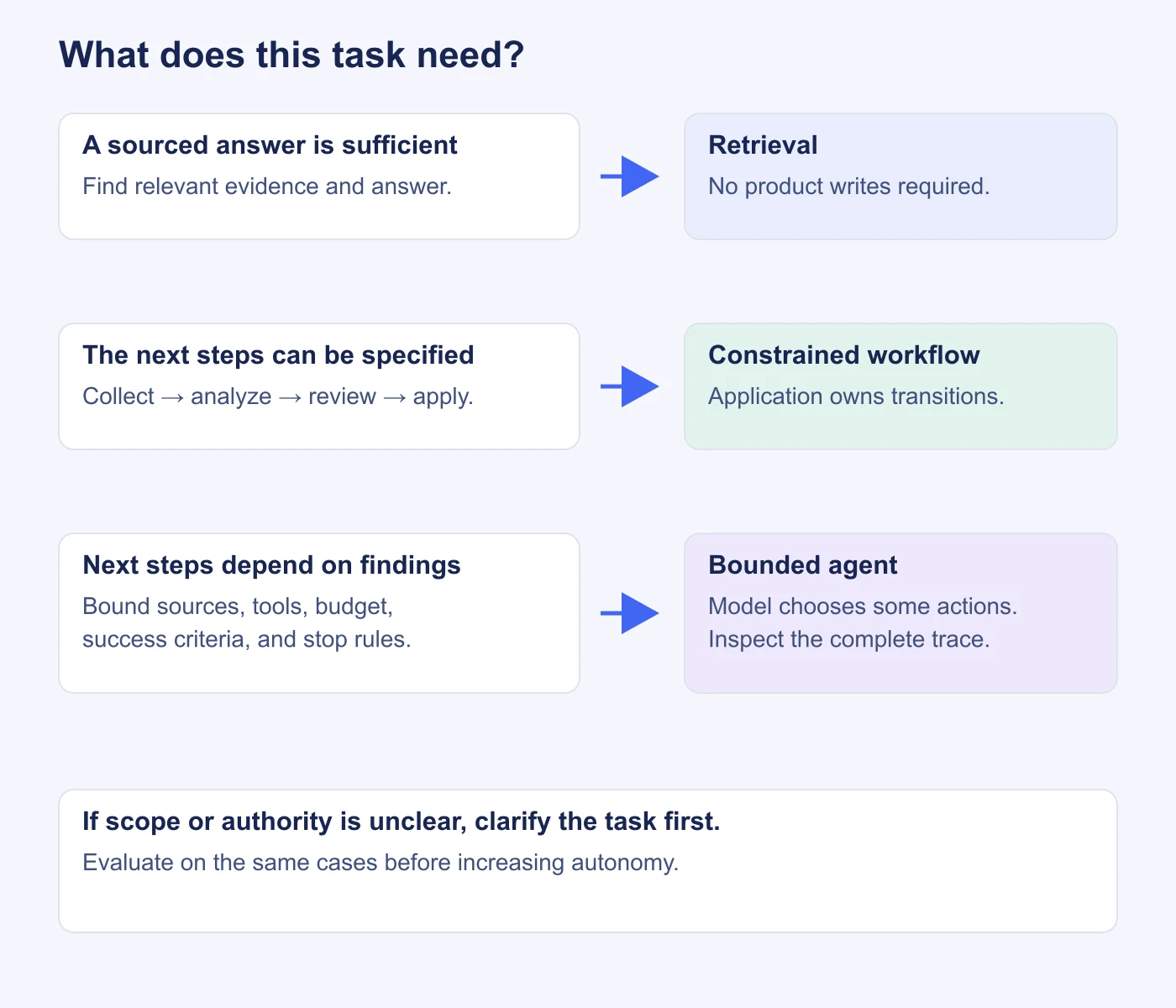
- Is a sourced answer sufficient? Start with retrieval. Test whether the evidence needed for the answer can actually be found.
- Are actions required, and can you specify their sequence? Use a constrained workflow with explicit branches and validation.
- Must the next useful action depend on new findings? Consider an agent for that bounded portion of the task.
- Are success, permissions, and stop conditions unclear? Clarify the task or keep the investigation human-led before granting autonomy.
Uncertainty alone does not justify an agent. If the team has not defined the product policy, an agent cannot resolve that missing decision through more tool calls. It should identify the gap and return it to the responsible person.
Example 1: answer an invitation-policy question
A support teammate asks, “Can a member invite someone as an Editor, and what happens after the link expires?” The available records include the current role policy, the invitation story, and its approved acceptance criteria.
Start with retrieval. Search the permitted records, retrieve the relevant sections, and answer with record identifiers and source dates. In the fictional Northstar policy, only administrators invite, and expired links lead to a replacement request. The answer should identify those sources rather than infer behavior from a screen label.
Test a contradiction as well: an old onboarding document says that all members may invite. The assistant should expose the disagreement and follow your documented source-precedence rule, or ask for clarification when no such rule exists. It should not silently blend both policies into a confident answer.
The smallest useful implementation has permission-aware retrieval, an answer format, and an abstention path. Giving it backlog-write access adds no value to this task.
Example 2: review feedback through known steps
Each week, the Product Owner wants a proposal for improving invitation recovery. The sequence is stable: read new or changed feedback, remove duplicate records, extract evidence, compare it with the current story, and produce suggested edits for review.
A constrained workflow fits because the team can define what happens next. If a source is missing, mark the run incomplete. If no relevant feedback exists, save a no-change result. If a proposed write is approved, recheck the target and apply only that operation.
The model's work is local to specific steps: interpret a report, identify a possible gap, or draft acceptance criteria. The application owns the source window, required output fields, approval state, and transition to writing.
A useful first release stops at the proposal. Test whether reviewers can trace each suggestion to evidence before adding a writer. This makes it possible to evaluate the analysis without introducing product-record changes at the same time.
Use a stable proposal identity and retain rejected suggestions. A rejected “extend expiry to 30 days” proposal is useful evidence about the analysis policy: the reports may support better recovery messaging without supporting a different security decision.
Example 3: investigate a failure whose next step is unknown
A Business Analyst asks why some invited teammates reach a no-access page. The initial evidence does not establish whether the cause is an expired invitation, a changed role policy, a workspace mismatch, or confusing copy.
A bounded read-only agent may be useful because the next source to inspect depends on intermediate findings. It might first read the story's acceptance criteria, then inspect linked support records, then compare a design note with the current role policy. If it finds evidence of workspace mismatch, the next useful question differs from the one it would ask after finding expiry.
Set a narrow objective: produce an evidence-linked explanation and unresolved questions for the invitation journey. Limit it to named sources, a maximum investigation budget, and read-only tools. Require it to stop when it has sufficient evidence, encounters denied access, reaches the budget, or needs a product-policy decision.
A valid result can be “The available records do not establish the cause.” The agent should identify which evidence is missing and who could provide it. Completing an investigation does not require inventing a root cause or creating a story.
Only after a person reviews the findings should any proposed product change enter a separate workflow. Adaptable investigation and authorized mutation are different responsibilities.
Place MCP at the tool and context connection
The same StoriesOnBoard context can support all three approaches. Retrieval may read a relevant story and its details. A workflow may compare a fixed slice with feedback. An agent may navigate related goals, steps, and stories as its investigation develops.
MCP provides a standardized way for an AI application to discover and invoke exposed operations; the application still decides how to use them. The official architecture overview describes this boundary. Do not treat the presence of an MCP connection as proof that an application has approval gates, scheduling, or safe retry behavior.
Check the tools and permission scope actually available in your connected environment. A product skill can describe a review method, while the host and integration enforce the operations the task may perform. Our MCP guide for product teams provides the broader context; our agent-ready backlog guide covers the product information those operations need.
Evaluate before increasing autonomy
Build a small test set from tasks your team actually performs. Include a clean case, missing evidence, contradictory policy, denied access, a duplicate report, and an interrupted operation where applicable. Write the acceptable outcome for each case before comparing approaches.
| Measure | How to inspect it |
|---|---|
| Task completion | Did the answer or proposal satisfy the stated question? |
| Evidence support | Can each material claim be traced to an allowed source? |
| Boundary behavior | Did the system stop, abstain, or ask when required? |
| State integrity | Were unapproved or stale changes prevented? |
| Review effort | How much correction and source checking did the reviewer need? |
| Total cost and latency | Include retrieval, tool calls, retries, and human review. |
Choose thresholds based on the task's consequences. A wrong source citation in a draft and an unauthorized change to a release have different impacts. Do not average a serious boundary violation away inside an otherwise high completion score.
Increase autonomy when a fixed sequence repeatedly fails because legitimate next steps vary, and when a bounded agent performs better on the same cases. Reduce autonomy when it loops, invents actions, misses stop conditions, or costs more review effort than it saves. Keep the comparison versioned so you can repeat it after model, tool, or policy changes.
Write a one-page implementation decision
Record the task, required result, allowed sources, allowed actions, chosen approach, approval boundary, stop conditions, and evaluation cases. For the invitation-policy question, that page should be short: sourced answer, current policy and story details, no writes, abstain on unresolved contradictions.
That decision is enough to start a useful experiment. You can add adaptive behavior later if the task evidence supports it. Prepare a focused product-context package so whichever approach you choose begins with the right goals, rules, and stories.