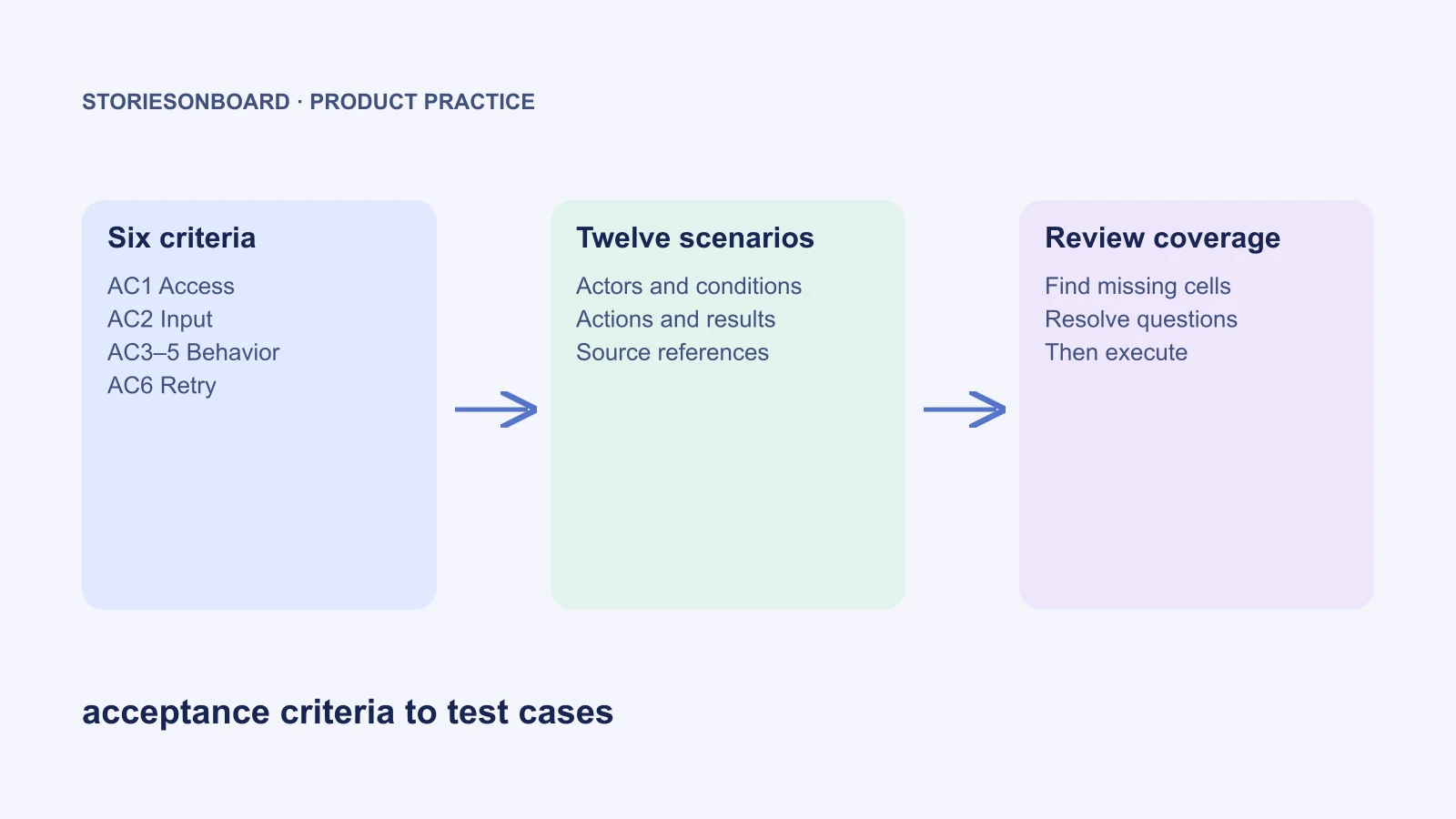
AI can turn acceptance criteria into a useful first set of test scenarios, but the number of generated tests does not prove coverage. Require every scenario to identify the criterion it checks, the conditions it needs, and the observable result. Then inspect the criteria that have no test and the tests that assume behavior nobody agreed.
The workflow is straightforward: assign criterion IDs, generate scenarios with traceability, review gaps and duplicates, and have QA validate the expected results before execution. Keep “scenario proposed,” “test implemented,” and “test passed” as separate states.
This guide uses a fictional workspace-invitation feature with six acceptance criteria and twelve reviewed scenarios. It extends the idea of AI-assisted test case creation with a complete traceability example. The scenarios are illustrative specifications, not evidence of tests run against a live product.
Start with six explicit acceptance criteria
The story is: “As a workspace administrator, I want to invite a teammate with an assigned role so that they can join the intended workspace.” The release supports single invitations with Viewer or Editor access. Bulk import, real-time collaboration, and billing changes are outside this example.
| ID | Acceptance criterion |
|---|---|
| AC1 | Only an authenticated Admin can create an invitation. A Member attempt is denied and creates no invitation. |
| AC2 | The form requires a syntactically valid email address. Invalid input shows a field error and preserves the entered value. |
| AC3 | The Admin selects Viewer or Editor. The confirmation shows the selected role, and acceptance grants that role rather than a broader one. |
| AC4 | A valid, unused invitation can be accepted by its intended recipient into the specified workspace. A second acceptance creates no additional membership. |
| AC5 | An invitation is valid for less than seven days from creation. At exactly seven days or later it cannot be accepted; the user sees a route to request a replacement. |
| AC6 | If invitation creation fails, the form retains the email and role, explains the failure, and allows retry. A retry after a definite failed creation creates at most one invitation. |
These are example product decisions. The seven-day boundary is deliberately exact so a reviewer can derive a test. They do not describe StoriesOnBoard's invitation policy. Real criteria should come from your approved requirements and include the relevant identity and service contracts.
AC6 distinguishes a definite failure from an unknown outcome. A network timeout after a successful server write requires an additional idempotency decision; the current criterion does not fully define it. Record that question instead of letting the generator silently decide how the product behaves.
Prompt for traceability and unknowns
Act as a QA reviewer proposing scenarios for AC1–AC6 below.
For each scenario return:
ID, linked AC IDs, actor, preconditions, action, observable expected result,
test layer, and unresolved questions.
Cover ordinary success, denied access, invalid input, boundaries,
repeat actions, and recovery where the criteria require them.
Do not invent requirements, expiry rules, UI labels, or delivery guarantees.
Return a criterion-to-test matrix and flag criteria with no scenario.
Keep proposed scenarios separate from executed test results.
If the expected result is ambiguous, ask a question instead of guessing.
Give the assistant the criteria and necessary product context together. If you use a story map, include the relevant goal, step, story details, and release boundary. Pulling only a card title such as “Invite teammate” leaves too much for the generator to invent.
Ask for a bounded set that covers distinct conditions. “Give me 50 tests” tends to reward volume. The useful unit is an independently meaningful behavior or boundary, not another paraphrase of the happy path.
Review twelve concrete scenarios
| Test | Criterion and setup | Action | Expected result |
|---|---|---|---|
| T01 | AC1, AC3; authenticated Admin, new address, Viewer. | Create the invitation. | One invitation is created; confirmation identifies the address, target workspace, and Viewer role. |
| T02 | AC1; authenticated Member and signed-out caller, as separate runs. | Attempt creation at the service boundary, not only through the UI. | Access is denied; no invitation record or delivery job is created. |
| T03 | AC2; Admin, email field contains “alex-at-example”. | Submit the form. | A field error appears; the original value remains; no invitation is created. |
| T04 | AC2; Admin, empty email field. | Submit the form. | A required-field error appears; the form remains available for correction. |
| T05 | AC3, AC4; valid Editor invitation for the intended recipient. | Review and accept it. | Confirmation and resulting membership both identify Editor in the specified workspace. |
| T06 | AC3, AC4; valid Viewer invitation for the intended recipient. | Accept and inspect granted access. | Viewer membership is created; no Editor or Admin capability is granted by the invitation. |
| T07 | AC4; invitation has already been accepted. | Attempt acceptance again. | No second membership or duplicate acceptance effect is created. |
| T08 | AC5; controlled clock at six days, 23 hours, 59 minutes after creation. | Accept the otherwise valid invitation. | It remains eligible for acceptance under the stated seven-day rule. |
| T09 | AC5; controlled clock exactly seven days after creation. | Attempt acceptance. | Acceptance is rejected and the replacement-request route is available. |
| T10 | AC6; service returns a definite failure before creating an invitation. | Submit with Editor selected. | The error is explained; email and Editor remain selected; retry is possible. |
| T11 | AC6; start from T10, then restore the service. | Retry the same invitation. | At most one invitation is created; the success result reflects the retained values. |
| T12 | AC4; valid invitation but a different authenticated recipient. | Attempt acceptance. | No membership is granted to the wrong recipient; the invitation remains protected. |
Some tests belong below the browser layer. T02 must inspect authorization and side effects. T08 and T09 need controlled time rather than waiting seven days. T10 and T11 need a known failure fixture. QA and engineering should choose implementation tools that can observe those conditions reliably.
The table intentionally avoids inventing exact error text or a particular API status code. Add those only when the product or interface contract defines them. T12 still needs a decision about the user-facing recovery path; the security expectation is clear, but the display behavior is not fully specified.
Find the deliberately omitted criterion
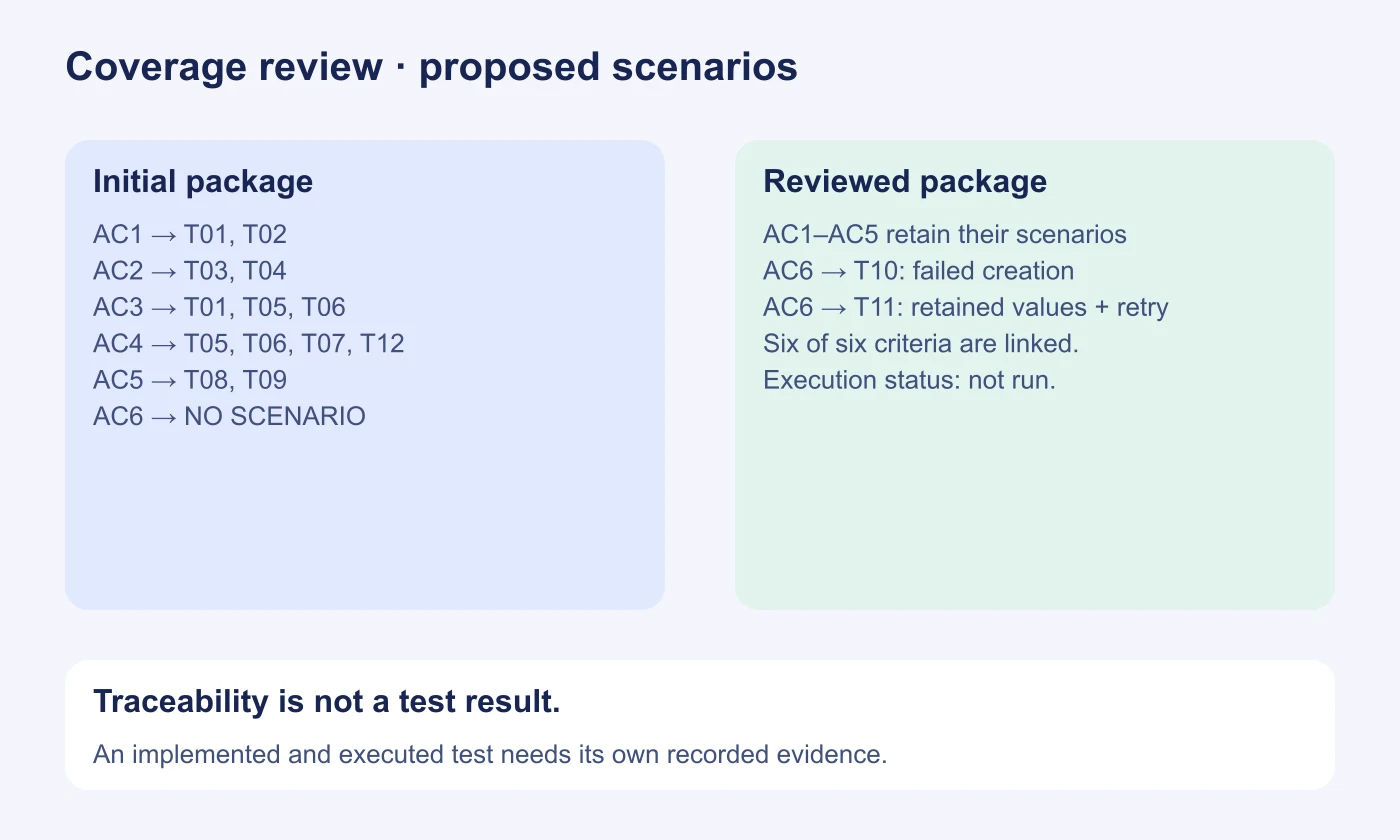
Imagine the first generated package contained T01–T09 and T12. It would look substantial: ten scenarios, multiple roles, expiry boundaries, and a repeated action. Yet it would contain no test for AC6.
| Criterion | Initial package | Reviewed package |
|---|---|---|
| AC1 | T01, T02 | T01, T02 |
| AC2 | T03, T04 | T03, T04 |
| AC3 | T01, T05, T06 | T01, T05, T06 |
| AC4 | T05, T06, T07, T12 | T05, T06, T07, T12 |
| AC5 | T08, T09 | T08, T09 |
| AC6 | No scenario: gap | T10, T11 |
The corrected package adds a failed-creation scenario and its retry. That improves criterion traceability from five of six to six of six. It does not establish complete behavioral coverage or a passed implementation. Each criterion can still contain untested variations.
Check duplicates, inventions, and weak assertions
Review every expected result against its criterion. A test that says “the invitation works correctly” cannot be graded consistently. Replace it with observable state, permission, or interface outcomes. A test that adds SMS delivery or an Owner role is outside the agreed feature.
Look for duplicates at the condition level. Two tests with the same actor, input class, action, and expected result may differ only in wording. Keep both only if they exercise a meaningful variation, such as a separate validation rule or client environment.
Inspect the negative paths as carefully as the happy path. A UI that hides an invitation control is not evidence that the service rejects a Member request. An error message is not evidence that no side effect occurred. Include the observations needed to establish the intended behavior.
Use the matrix to ask better questions, not to force every row green. In this example, unknown outcomes after network timeouts need an explicit idempotency requirement. That should become a product decision and potentially new criteria before tests assert a particular solution.
Hand off a reviewed package, then track execution separately
The package should include the source story and revision, AC IDs, scenario table, traceability matrix, unresolved questions, reviewer, and intended test layers. Link implemented automated tests back to those scenario IDs where practical.
Record execution environment, build, date, and result only when a test actually runs. A generated scenario has no pass status. An implemented test that has not run is still unverified. A passed test proves its assertions under its recorded conditions, not every possible interpretation of the requirement.
When a criterion changes, use the links to find affected scenarios and tests. Preserve old revisions for interpreting previous results. Our acceptance criteria examples can help improve the input before generation.
For your next story, ask AI for the scenarios and the coverage matrix in the same response. Review the empty cells first. They are often more informative than the longest list of tests.